Accelerate private markets due diligence
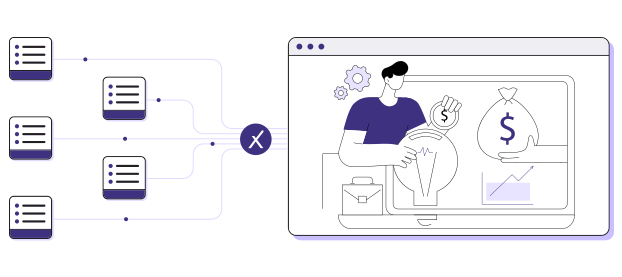
Turn scattered track records and VDRs into structured, comparable data — so investment teams can focus on judgment and modeling, not data wrangling.
Heading 1
with a request body that specifies how to map the columns of your import file to the associated CRM properties in HubSpot.... In the request JSON, define the import file details, including mapping the spreadsheet's columns to HubSpot data. Your request JSON should include the following fields:... entry for each column.
Who this is for
- Investment teams
- Primary and secondary investors
- CIOs and Investment Committees

Heading 1
with a request body that specifies how to map the columns of your import file to the associated CRM properties in HubSpot.... In the request JSON, define the import file details, including mapping the spreadsheet's columns to HubSpot data. Your request JSON should include the following fields:... entry for each column.
The job today
Due diligence starts with data — but most of the effort goes into preparing it.
Primary teams sift through track record files to understand historical performance and manager behavior.
Secondary teams comb through VDRs to reconstruct fund exposures, cash flows, and asset-level details.
Across both cases, the pattern is the same:
- Data is scattered across PDFs, spreadsheets, and folders
- Formats vary by manager, fund, and deal
- Teams spend most of their time normalizing data just to make it usable
By the time models are built, deadlines are tight — and the underlying data work is rarely reused.
Heading 1
with a request body that specifies how to map the columns of your import file to the associated CRM properties in HubSpot.... In the request JSON, define the import file details, including mapping the spreadsheet's columns to HubSpot data. Your request JSON should include the following fields:... entry for each column.
Why this breaks at scale
Time
Each new opportunity restarts the same process. Teams rebuild diligence datasets from scratch, deal after deal.
Risk
Manual data handling increases the likelihood of:
- Inconsistent assumptions
- Missed details buried in documents
- Errors that propagate into models and IC materials
Opportunity cost
The majority of diligence effort goes into data preparation — not:
- Analyzing risk
- Comparing managers
- Developing differentiated views
Worse, once a deal closes or is passed on, the data is often lost.
How Tamarix enables this use case
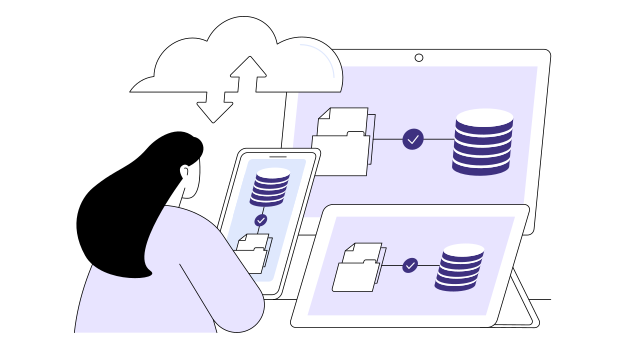
Tamarix removes data wrangling from the diligence process.
Heading 1
with a request body that specifies how to map the columns of your import file to the associated CRM properties in HubSpot.... In the request JSON, define the import file details, including mapping the spreadsheet's columns to HubSpot data. Your request JSON should include the following fields:... entry for each column.
What changes
Before Tamarix
-
Diligence means rebuilding datasets from PDFs and spreadsheets for every opportunity.
With Tamarix
-
Data is structured once, reused across analyses, and retained to inform future decisions.
Outcomes
LPs using Tamarix to accelerate due diligence typically achieve:
-
Faster turnaround on investment evaluations
-
Less time spent on data preparation
-
More consistent and comparable analyses
-
A growing proprietary view of managers, funds, and markets
Diligence effort shifts from data wrangling to decision-making.
How this fits into the broader system
This use case is powered by Tamarix’s unified ingestion, validation, and analytics layer — the same foundation that supports portfolio monitoring, pacing, and reporting workflows.
Diligence data does not disappear.
It becomes part of the system.
Heading 1
with a request body that specifies how to map the columns of your import file to the associated CRM properties in HubSpot.... In the request JSON, define the import file details, including mapping the spreadsheet's columns to HubSpot data. Your request JSON should include the following fields:... entry for each column.
Due diligence shouldn’t start from zero every time.
It should compound.

Heading 1
with a request body that specifies how to map the columns of your import file to the associated CRM properties in HubSpot.... In the request JSON, define the import file details, including mapping the spreadsheet's columns to HubSpot data. Your request JSON should include the following fields:... entry for each column.
FAQ — Accelerate Due Diligence
Yes. Tamarix supports diligence workflows for both primary investments and secondary transactions.
Tamarix can process track record files, VDR materials, fund reports, and other GP-provided diligence documents.
Yes. Extracted data is retained and normalized, allowing teams to build a proprietary dataset over time.
By delivering data in a consistent, structured format, Tamarix allows teams to focus on modeling and analysis rather than preparation.
Because data extraction and structuring are automated, teams can move from documents to analysis much faster than with manual workflows.
Heading 1
with a request body that specifies how to map the columns of your import file to the associated CRM properties in HubSpot.... In the request JSON, define the import file details, including mapping the spreadsheet's columns to HubSpot data. Your request JSON should include the following fields:... entry for each column.