Who this is for Img

Who this is for

  • LP operations teams responsible for GP data ingestion and quality
  • Finance and reporting teams dependent on accurate, timely data
  • Investment teams relying on clean data for monitoring and decisions

It is most relevant for LPs managing growing, multi-manager private markets portfolios.

Heading 1

with a request body that specifies how to map the columns of your import file to the associated CRM properties in HubSpot.... In the request JSON, define the import file details, including mapping the spreadsheet's columns to HubSpot data. Your request JSON should include the following fields:... entry for each column.

The job today Img

The job today

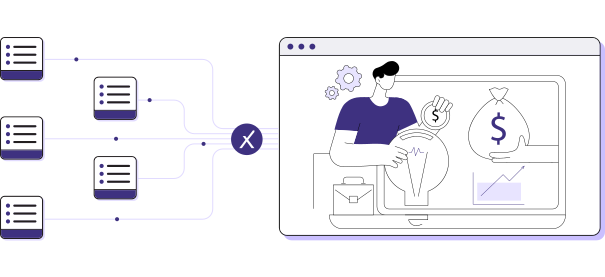
Private markets data management is still a fragmented, manual process. It is treated as a series of handoffs — from inboxes to extraction tools to spreadsheets to dashboards — with no single system owning accuracy, continuity, or accountability

In practice, teams:

  • Track GP communications across email and multiple portals
  • Download and organize documents manually
  • Re-key data into spreadsheets or point tools
  • Reconcile inconsistencies downstream during reporting or analysis

As portfolios grow, data management becomes a recurring operational burden rather than a reliable foundation.

Heading 1

with a request body that specifies how to map the columns of your import file to the associated CRM properties in HubSpot.... In the request JSON, define the import file details, including mapping the spreadsheet's columns to HubSpot data. Your request JSON should include the following fields:... entry for each column.

Why this breaks at scale

Over time, LPs are left with a system that is costly to operate, slow to update, and difficult to trust — precisely when accuracy and timeliness matter most. As a result, LPs optimize around individual tools — not the system — and data management never becomes reliable infrastructure.

Cost

Cost

Manual data management is expensive to sustain.

As portfolios grow, LPs add operational effort through headcount, consultants, or outsourced services — without ever eliminating the underlying work. What looks manageable at small scale becomes a permanent cost center at institutional scale.

Time

Time

Each new manager, fund, or asset class adds incremental processing time.

Data arrives continuously, but teams still process it in batches, creating delays between when information is received and when it becomes usable. The result is stale data powering critical workflows.

Risk of error

Risk of error

Manual entry, spreadsheet workflows, and reconciliation across tools introduce inconsistencies and mistakes. These errors are often discovered late — during reporting, audits, or investment reviews — when the cost of correction is highest.

How Tamarix enables automated data management

Tamarix treats data management as a continuous system, not a preprocessing step for reporting or analytics. This use case is powered by Tamarix’s integrated system across Document Collection, Data Extraction, and Data Validation & Auditability.

01 Document collection

Document collection

Tamarix continuously monitors GP notifications and portals, automatically retrieving all relevant documents as they become available.

Nothing is missed. No chasing. No manual tracking.

02 Data extraction

Data extraction

As documents arrive, Tamarix categorizes them, understands which KPIs matter, and extracts structured data automatically — without templates or mapping projects.

Data becomes usable minutes after arrival, not weeks later.

03 Data validation & auditability

Data validation & auditability

Extracted data is source-linked and checked for consistency and logic before flowing downstream. Validation workflows can be automated, handled internally, or managed by Tamarix.

Every datapoint remains auditable and defensible.

Heading 1

with a request body that specifies how to map the columns of your import file to the associated CRM properties in HubSpot.... In the request JSON, define the import file details, including mapping the spreadsheet's columns to HubSpot data. Your request JSON should include the following fields:... entry for each column.

What changes with Tamarix

Before Tamarix

  • Manual document tracking
  • Spreadsheet-driven data entry
  • Reconciliation across tools
  • Limited confidence in downstream outputs

With Tamarix

  • Continuous, automated data ingestion
  • Structured, validated data as standard
  • One system that owns data accuracy, history, and reuse across all workflows
  • Data that’s ready the moment it arrives

Outcomes

  • Lower operating cost and fewer errors by eliminating manual and duplicated data work
  • Portfolio monitoring and reporting stay current, without reconciliation cycles
  • Earlier, better-informed decisions, powered by reliable data rather than assumptions
system

How this fits into the broader system

Automated data management is the foundation for every other Tamarix use case — from reporting automation to portfolio monitoring, analytics, and decision support.

It’s not a standalone workflow.

It’s the operating layer that makes all other LP workflows possible.

Heading 1

with a request body that specifies how to map the columns of your import file to the associated CRM properties in HubSpot.... In the request JSON, define the import file details, including mapping the spreadsheet's columns to HubSpot data. Your request JSON should include the following fields:... entry for each column.

Data management shouldn’t be a recurring task. It should run continuously in the background.

Tamarix turns private markets data management into reliable infrastructure.

Heading 1

with a request body that specifies how to map the columns of your import file to the associated CRM properties in HubSpot.... In the request JSON, define the import file details, including mapping the spreadsheet's columns to HubSpot data. Your request JSON should include the following fields:... entry for each column.

Data management

FAQ — Automate Data Management

Answers to the most common questions about data management.

It means GP documents and data are collected, structured, validated, and kept up to date automatically — without manual entry, reconciliation, or template maintenance.

Spreadsheets and point tools require manual updates and reconciliation. Tamarix provides a single, continuously updated system of record that feeds all downstream workflows.

Tamarix can replace fragmented tools or integrate with existing systems via its API-first architecture, depending on an LP’s preferences.

All data is source-linked and auditable. Validation workflows can be automated, handled internally, or managed end to end by Tamarix to meet institutional standards.

Tamarix supports private equity, venture capital, private debt, real estate, and infrastructure within a single unified platform.

Heading 1

with a request body that specifies how to map the columns of your import file to the associated CRM properties in HubSpot.... In the request JSON, define the import file details, including mapping the spreadsheet's columns to HubSpot data. Your request JSON should include the following fields:... entry for each column.