Who this is for Img

Who this is for

  • Investment teams
  • CIOs and Heads of Investments
  • Portfolio construction and risk teams

Heading 1

with a request body that specifies how to map the columns of your import file to the associated CRM properties in HubSpot.... In the request JSON, define the import file details, including mapping the spreadsheet's columns to HubSpot data. Your request JSON should include the following fields:... entry for each column.

The job today Img

The job today

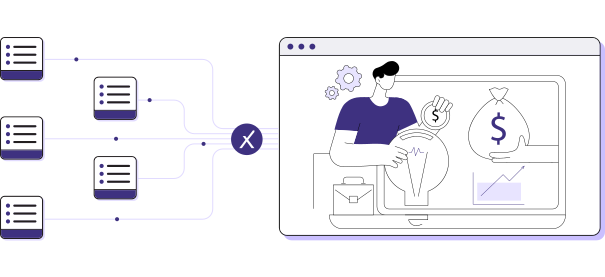
Monitoring private markets portfolios is harder than it should be.

Investment teams try to understand:

  • Where exposures come from across funds, managers, strategies, vintages, sectors, and geographies
  • What is driving performance — and what is not
  • How outcomes compare to budgets, plans, and expectations
  • Where risks and concentrations are building

But answers are spread across quarterly reports, spreadsheets, and static dashboards. By the time views are consolidated, the data is already outdated.

Monitoring becomes backward-looking — not decision-ready.

Heading 1

with a request body that specifies how to map the columns of your import file to the associated CRM properties in HubSpot.... In the request JSON, define the import file details, including mapping the spreadsheet's columns to HubSpot data. Your request JSON should include the following fields:... entry for each column.

Why this breaks at scale

time

Time

As portfolios diversify, building a coherent view across funds, assets, and dimensions becomes a manual exercise repeated every quarter.

risk

Risk

Without continuous visibility, LPs struggle to:

  • Identify concentration risk early
  • Understand shifts in exposure or performance drivers
  • Detect emerging issues with managers or strategies
cost

Opportunity cost

Static monitoring limits the ability to:

  • Rebalance risk
  • Adjust pacing
  • Act early on under- or over-performing exposures

Insights arrive too late to matter.
How Tamarix enables this use case

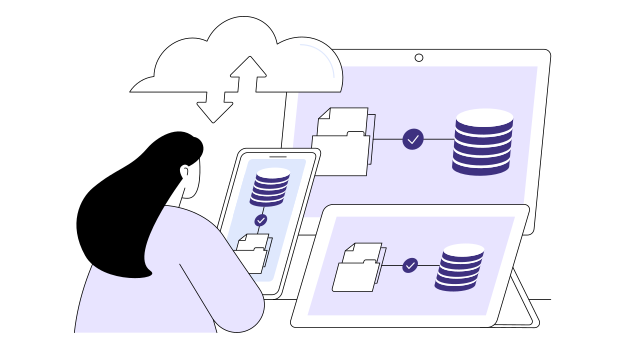
Tamarix enables investment monitoring by keeping portfolio analytics continuously aligned with underlying data.

01 Ingest

Ingest

GP documents and data are collected, extracted, and validated automatically.

02 Monitor

Monitor

Exposures, valuations, cash flows, and performance update continuously — at fund level and full look-through.

03 Manage

Manage

Investment teams analyze the portfolio using live views of:

  • Exposure by GP, strategy, vintage, sector, geography, and asset
  • Performance metrics including TVPI, IRR, and DPI — and how they evolve over time
  • Concentration risk across managers, assets, and themes

Monitoring becomes an always-on capability, not a quarterly exercise.

Heading 1

with a request body that specifies how to map the columns of your import file to the associated CRM properties in HubSpot.... In the request JSON, define the import file details, including mapping the spreadsheet's columns to HubSpot data. Your request JSON should include the following fields:... entry for each column.

What changes

Before Tamarix

  • Monitoring relies on static snapshots, delayed rollups, and manual reconciliation across sources.

With Tamarix

  • Investment teams work from a continuously updated portfolio view that explains what changed, where it came from, and why.

Outcomes

LPs using Tamarix to monitor investments typically gain:

  • Clear visibility into exposure and performance drivers

  • Early detection of concentration and risk buildup


  • Better understanding of performance dynamics across TVPI, IRR, and DPI

  • Faster insight into quarter-over-quarter and year-over-year changes

Monitoring supports decisions — not just reporting.

system

How this fits into the broader system

This use case is powered by Tamarix’s unified ingestion, validation, and portfolio analytics layer — the same foundation that supports reporting automation, pacing analysis, and operational workflows.

Monitoring is not a dashboard.
 It is a system capability.

Heading 1

with a request body that specifies how to map the columns of your import file to the associated CRM properties in HubSpot.... In the request JSON, define the import file details, including mapping the spreadsheet's columns to HubSpot data. Your request JSON should include the following fields:... entry for each column.

Investment insight shouldn’t arrive after the quarter closes.

It should be available when decisions are made.

Heading 1

with a request body that specifies how to map the columns of your import file to the associated CRM properties in HubSpot.... In the request JSON, define the import file details, including mapping the spreadsheet's columns to HubSpot data. Your request JSON should include the following fields:... entry for each column.

Data management

FAQ — Monitor Investments

Answers to the most common questions about monitoring.

Tamarix supports monitoring at both the fund level and full look-through across underlying assets.

Yes. Tamarix surfaces performance drivers, valuation changes, and exposure shifts across managers, strategies, sectors, and geographies.

Yes. Performance can be benchmarked against peer funds and public market equivalents to assess opportunity cost and manager selection.

Views update continuously as new GP data is ingested and validated.

Dashboards show point-in-time data. Tamarix delivers continuously updated monitoring aligned with underlying documents and data.

Heading 1

with a request body that specifies how to map the columns of your import file to the associated CRM properties in HubSpot.... In the request JSON, define the import file details, including mapping the spreadsheet's columns to HubSpot data. Your request JSON should include the following fields:... entry for each column.