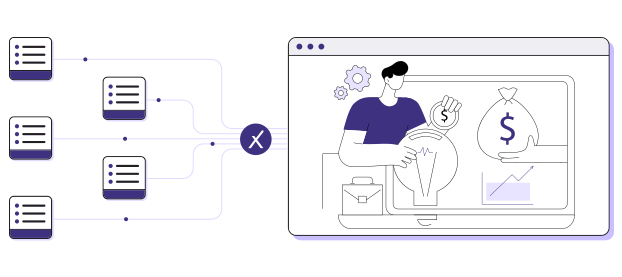
Optimize pacing without guesswork
Plan commitments, liquidity, and exposure using continuously updated portfolio data — so LPs can deploy capital efficiently without taking on unnecessary risk.
Heading 1
with a request body that specifies how to map the columns of your import file to the associated CRM properties in HubSpot.... In the request JSON, define the import file details, including mapping the spreadsheet's columns to HubSpot data. Your request JSON should include the following fields:... entry for each column.
Who this is for
- Investment teams
- CIOs and Heads of Portfolio Construction
- Strategy and asset allocation teams

Heading 1
with a request body that specifies how to map the columns of your import file to the associated CRM properties in HubSpot.... In the request JSON, define the import file details, including mapping the spreadsheet's columns to HubSpot data. Your request JSON should include the following fields:... entry for each column.
The job today
Pacing is one of the hardest problems in private markets.
Investment teams try to balance:
- Deploying enough capital to avoid cash drag and missed returns
- Preserving liquidity to meet future obligations
- Managing exposure across vintages, strategies, and markets
To do this, teams build complex Excel models:
- Pulling historical J-curves and assumptions
- Updating cash flows from existing investments
- Incorporating new fund commitments and pipeline scenarios
- Rebuilding models whenever data changes
The setup takes weeks. Maintenance never ends. And the inputs are often already outdated.
Heading 1
with a request body that specifies how to map the columns of your import file to the associated CRM properties in HubSpot.... In the request JSON, define the import file details, including mapping the spreadsheet's columns to HubSpot data. Your request JSON should include the following fields:... entry for each column.
Why this breaks at scale
Under-committing
When LPs under-commit, capital sits idle and returns suffer. Alpha is missed simply because capital was not deployed on time.
Over-committing
When LPs over-commit, they take on:
- Liquidity risk
- Forced asset sales
- Unintended exposure concentration
Opportunity cost
Teams spend disproportionate time:
- Maintaining pacing spreadsheets
- Updating assumptions manually
- Re-running scenarios after every data change
Pacing becomes reactive instead of strategic.

How Tamarix enables this use case
Tamarix enables pacing by grounding forecasts in live portfolio data.
Heading 1
with a request body that specifies how to map the columns of your import file to the associated CRM properties in HubSpot.... In the request JSON, define the import file details, including mapping the spreadsheet's columns to HubSpot data. Your request JSON should include the following fields:... entry for each column.
What changes
Before Tamarix
-
Pacing relies on static models, manual updates, and assumptions that drift from reality.
With Tamarix
-
Pacing scenarios are built on continuously updated data, making assumptions explicit and impacts immediately visible.
Outcomes
LPs using Tamarix to optimize pacing typically achieve:
-
More efficient capital deployment
-
Reduced liquidity and exposure risk
-
Faster scenario analysis with fewer manual models
-
Greater confidence in commitment decisions
Pacing shifts from spreadsheet maintenance to strategic planning.
How this fits into the broader system
This use case is powered by Tamarix’s unified ingestion, validation, and portfolio analytics layer — the same foundation that supports investment monitoring, reporting automation, and operational workflows.
Pacing is not a standalone model.
It is a system-level capability.
Heading 1
with a request body that specifies how to map the columns of your import file to the associated CRM properties in HubSpot.... In the request JSON, define the import file details, including mapping the spreadsheet's columns to HubSpot data. Your request JSON should include the following fields:... entry for each column.
Pacing shouldn’t depend on fragile spreadsheets.
It should be grounded in live portfolio data.

Heading 1
with a request body that specifies how to map the columns of your import file to the associated CRM properties in HubSpot.... In the request JSON, define the import file details, including mapping the spreadsheet's columns to HubSpot data. Your request JSON should include the following fields:... entry for each column.
FAQ — Optimize Pacing
Tamarix uses continuously updated portfolio data from existing investments and applies forecasting logic to project cash flows and NAVs over time.
Yes. LPs can assess the impact of new fund commitments and pipeline investments at both the fund and portfolio level.
Traditional models rely on static data and manual updates. Tamarix keeps inputs current and scenarios aligned with reality.
Yes. Pacing analysis spans private equity, venture capital, private debt, real estate, and infrastructure.
Scenarios update whenever underlying portfolio data changes, enabling faster and more reliable decision-making.
Heading 1
with a request body that specifies how to map the columns of your import file to the associated CRM properties in HubSpot.... In the request JSON, define the import file details, including mapping the spreadsheet's columns to HubSpot data. Your request JSON should include the following fields:... entry for each column.