Financial Statements from Private Equity GPs: What LPs Need to Review
What the FS contains, how it differs from the QR and CAS, and how LP finance, accounting, and investment teams use it for valuation validation, fee audit, and compliance.
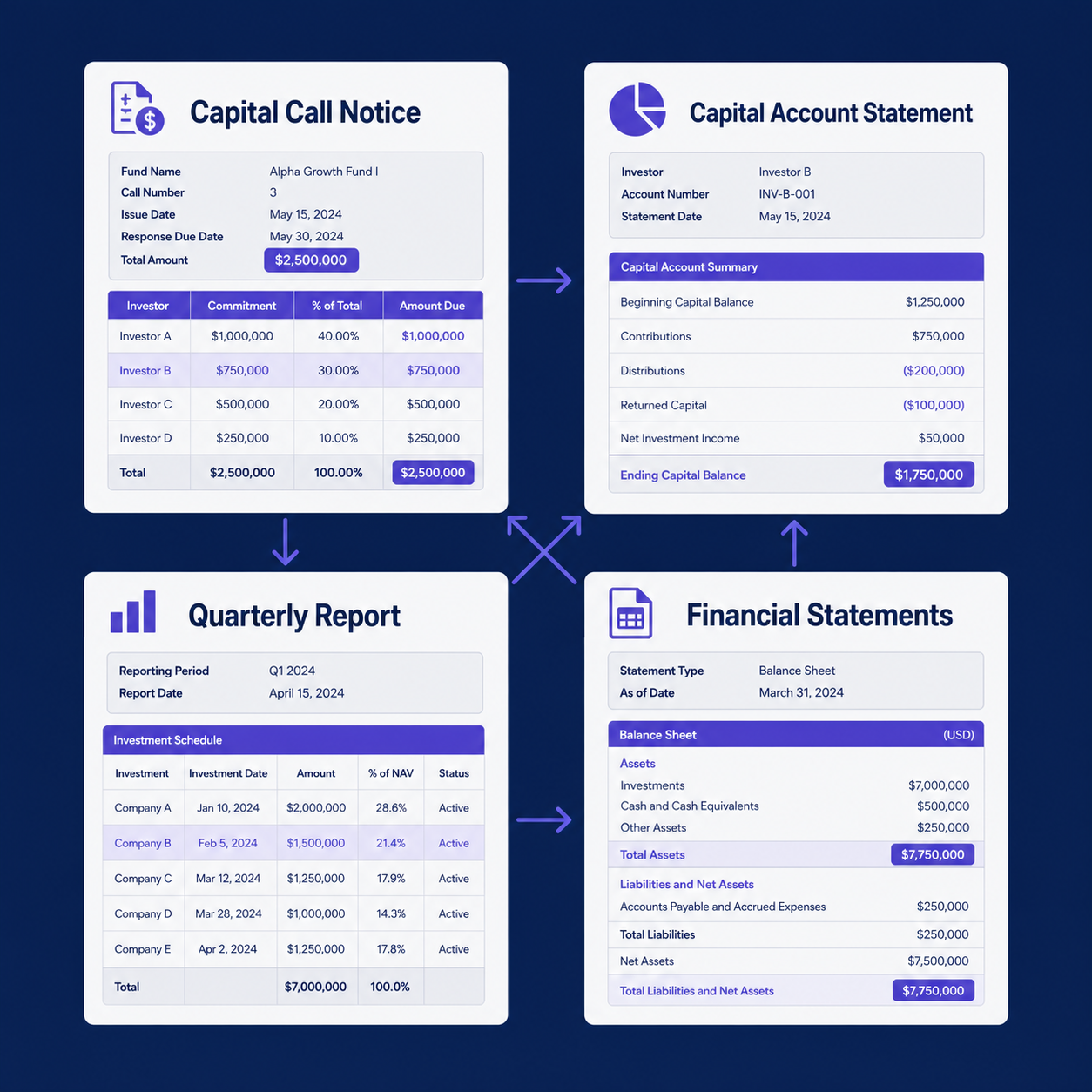
Of the four core documents an LP receives from a GP, the Financial Statements (FS) are the most formally rigorous and — for most LP teams — the least read. The quarterly report arrives first and gets circulated to the investment team. The capital account statement goes to finance for reconciliation. The financial statements land in a shared drive and stay there until an audit query forces someone to open them.
That's a mistake. The FS contains information that none of the other documents provide: audited fair values, explicit valuation methodology disclosures, a complete picture of fund-level liabilities, and independently verified accounting for every fee charged to the fund. For LP finance and accounting teams, it is the document with the highest evidential value. For investment teams scrutinising aggressive GP marks or preparing for LP advisory committee meetings, it is the document with the deepest due diligence value.
This guide covers what the FS contains component by component, how it differs from the QR and CAS, how different LP teams use it, the fair value hierarchy that governs private markets valuations, and how to use the FS effectively for fee audit and compliance.
This article is part of the Tamarix series on GP fund documents. For an overview of all four document types, start with The LP's Guide to GP Fund Documents.
How the FS Fits Into the LP Reporting Stack
The FS sits at the top of the reporting hierarchy in terms of formal rigour — it is the only document that is independently audited and prepared under a recognised accounting standard (US GAAP or IFRS). Everything else an LP receives from a GP — the QR, the CAS, the notices — is produced by the GP unilaterally, without independent verification.
This distinction matters more in some contexts than others. For routine quarterly monitoring, the QR is more useful — it is timelier, more narrative, and more focused on portfolio activity. But for valuation validation, fee disputes, or regulatory reporting, the FS is the authoritative reference.
|
|
CAS |
QR |
Financial Statements |
|
Nature |
LP-specific position record |
Management report — narrative & performance |
Formal accounting document — audited |
|
Prepared by |
GP (fund administrator) |
GP (investor relations) |
GP + independent auditor |
|
Accounting standard |
None — proprietary format |
None — proprietary format |
US GAAP or IFRS |
|
Valuation detail |
NAV figure only |
Methodology noted in write-ups |
Full methodology + auditor sign-off |
|
Primary audience |
Accounting, Finance |
Investment Team, CIO |
Finance, Accounting, Audit, Legal |
|
Frequency / lag |
Quarterly, 45–90 day lag |
Quarterly, 45–90 day lag |
Quarterly unaudited + annual audited; up to 120 day lag for annual |
|
Key use case |
Position tracking, reconciliation |
Look-through, performance monitoring |
NAV validation, fee audit, compliance, regulatory reporting |
One practical implication: the FS and QR may report different fair values for the same investment. This is not necessarily an error — the QR may use a preliminary or estimated mark that is later revised for the audited FS. But persistent or significant discrepancies between QR and FS valuations are worth investigating, as they may signal valuation methodology changes or delayed write-downs.
Financial Statement Components: What Each One Contains
A standard private equity fund FS contains seven main components. Not every fund will include all of them in every reporting period — quarterly FS may be unaudited and less detailed than annual FS — but a full annual audited FS will typically include all of the following.
|
Component |
What It Contains |
LP Use Case |
|
Statement of Assets and Liabilities (Balance Sheet) |
Fund assets: portfolio investments at fair value, cash, receivables. Fund liabilities: management fees payable, accrued expenses, borrowings |
NAV validation; assess fund-level leverage and liability profile |
|
Statement of Operations (Income Statement) |
Realised and unrealised gains/losses; management fees; fund expenses; interest income; carried interest accruals |
Fee validation against LPA; performance attribution; carried interest monitoring |
|
Statement of Changes in Partners' Capital |
Movement in LP capital accounts: contributions, distributions, income/loss allocation, beginning and ending balances per LP class |
Cross-reference against CAS; validate LP-level allocations; reconcile to internal records |
|
Schedule of Investments |
All portfolio companies with cost and fair value; often includes valuation methodology, ownership %, and investment date |
Most detailed look-through available; NAV validation; regulatory reporting |
|
Statement of Cash Flows |
Actual cash movements in and out of the fund during the period, split into operating activities (fee payments, working capital movements, FX effects on cash) and investing activities (capital deployed into portfolio companies, proceeds from disposals, income distributions received). Reconciles to closing cash and cash equivalents held at fund level. |
Reconcile distributions received against fund-level cash outflows; validate that capital calls are reflected in investing activity; cross-check closing cash against balance sheet |
|
Notes to Financial Statements |
Accounting policies; fee structures; related party transactions; commitments and contingencies; significant events |
Fee audit; side letter compliance; governance review; identify related party issues |
|
Auditor's Report |
Independent auditor's opinion on whether FS present fairly, in all material respects, the financial position of the fund |
Confirms FS reliability; flags qualifications, emphasis of matter, or going concern issues |
Quarterly vs. Annual FS: Most funds produce quarterly unaudited financial statements with a 45–90 day lag, and annual audited statements with a 90–120 day lag. The annual audited FS is the authoritative document — it has been reviewed by an independent auditor and prepared under GAAP or IFRS. Quarterly FS are useful for interim monitoring but should be treated as estimates, not final figures.
The Schedule of Investments: The FS's Most Valuable Section for LPs
For most LP teams, the Schedule of Investments is the section of the FS they will interact with most directly. It provides the most complete and formally verified look-through data available — a line-by-line listing of every investment in the fund's portfolio, with cost, fair value, and valuation methodology.
Unlike the investment schedule in the QR — which is a management report and may use preliminary or estimated marks — the Schedule of Investments in the FS reflects audited fair values, prepared under GAAP or IFRS fair value measurement standards. This makes it the most reliable source for NAV validation and LP financial statement preparation.
|
Field |
What It Shows |
Why It Matters vs. QR |
|
Company name and description |
Legal entity name; often includes business description |
More precise than QR — legal names rather than trading names |
|
Investment type / security |
Equity, preferred equity, debt, warrant, co-investment |
FS typically provides more granular security-level detail than QR |
|
Cost / amortised cost |
Capital invested at cost; debt instruments at amortised cost |
Audited figure — most reliable cost basis available; preferred for LP financial statement preparation |
|
Fair value |
Current mark at reporting date — audited |
Audited fair value vs. QR unaudited mark — discrepancies are a flag |
|
Valuation methodology |
Level 1 / 2 / 3 hierarchy; specific methodology (comps, DCF, cost) |
Critical for NAV validation — FS discloses methodology explicitly, QR often doesn't |
|
% of net assets |
Each investment as a percentage of total fund NAV |
Useful for concentration analysis; FS typically more precise than QR |
|
Geographic / sector classification |
Country and/or industry of the portfolio company |
May differ from QR classification — normalise to consistent taxonomy |
The valuation methodology column in the Schedule of Investments is particularly important. It classifies each investment according to the fair value hierarchy — Level 1, Level 2, or Level 3 — and often discloses the specific methodology used (comparable company analysis, discounted cash flow, recent transaction price, cost). This information is frequently absent or vague in the QR.
The Fair Value Hierarchy: Understanding GP Marks
All private markets FS prepared under US GAAP (ASC 820) or IFRS (IFRS 13) classify investments according to a three-level fair value hierarchy. The level assigned to each investment reflects how much the valuation relies on observable market data versus GP judgement. Understanding this hierarchy is essential for LP teams assessing the reliability of GP marks.
|
Level |
Definition |
Common in Private Markets? |
LP Implication |
|
Level 1 |
Quoted prices in active markets for identical assets |
Rare — publicly traded securities only |
Objective mark; no valuation risk |
|
Level 2 |
Observable inputs other than Level 1 prices (e.g. recent transactions, comparable public comps) |
Moderate — used for debt instruments, some co-investments |
Some subjectivity; comparable selection matters |
|
Level 3 |
Unobservable inputs — GP's own models and judgement |
Dominant — most PE, VC, and illiquid credit investments |
Highest valuation risk; most important to scrutinise |
In practice, the vast majority of private equity, venture capital, and illiquid credit investments are classified as Level 3. This is not a red flag in itself — it reflects the illiquid nature of the asset class, where quoted prices and directly comparable observable inputs are rarely available. But it does mean that the quality of GP marks depends entirely on the rigour of the underlying valuation model and the independence of the review process.
For LP teams, the key questions when reviewing the fair value hierarchy disclosure are: Has the Level 3 proportion changed significantly quarter-on-quarter? Have any investments moved between levels — and if so, why? Are the valuation methodologies consistent with prior periods? Significant changes in methodology — particularly switches from a comps-based approach to a cost or DCF approach — warrant follow-up.
How Different LP Teams Use the Financial Statements
Finance and Accounting: Audit, Reconciliation, and Compliance
For finance and accounting teams, the FS serves three primary functions. First, it is the reference document for LP-level financial statement preparation — the audited fund-level figures flow into the LP's own accounts, and any discrepancy needs to be explained. Second, it supports the annual audit process: LP auditors will request the GP's audited FS as supporting evidence for the LP's investment valuations. Third, it enables fee reconciliation at the highest level of detail — the notes disclose management fees, expense allocations, and carried interest accruals in a format that can be validated against LPA terms line by line.
Finance teams should also review the Statement of Changes in Partners' Capital carefully. This statement shows the movement in each LP's capital account over the period — contributions, distributions, income/loss allocation — and should reconcile to the CAS. Discrepancies here are material and require resolution with the GP before the LP's own accounts can be finalised.
Investment Team: Valuation Validation and NAV Quality
Investment teams use the FS primarily for valuation validation — particularly for funds where the QR marks have seemed aggressive or inconsistent with sector trends. The Schedule of Investments provides audited fair values and methodology disclosures that the QR typically does not, enabling a more rigorous assessment of whether GP marks are reasonable.
The investment team's FS review is typically less systematic than the finance team's — it tends to be triggered by a specific concern rather than performed as a routine quarterly exercise. But for funds where NAV movements have been unexpectedly large or where valuation methodology has changed, a careful FS review is time well spent.
Legal and Compliance: Notes and Related Party Review
Legal and compliance teams focus primarily on the notes to the financial statements. The notes disclose related party transactions — including management fees paid to GP affiliates, monitoring fees charged to portfolio companies, and transactions between the fund and other GP-managed vehicles. These disclosures are important for conflict of interest monitoring and for validating that the GP is complying with the terms of the LPA and any side letter provisions.
The notes also disclose commitments and contingencies — pending litigation, guarantee obligations, or contingent liabilities that could affect the fund's net asset value or future cash flows. These disclosures are not available in the QR or CAS and are only accessible through the FS.
Processing Financial Statements at Scale: The Core Challenges
Delivery lag
Annual audited FS typically arrive 90–120 days after fiscal year end — meaning a December 31 year-end fund delivers audited statements in April or May. This lag is structural: the audit process takes time. For LP teams that need year-end figures for their own financial statements or regulatory filings, this lag creates a timing mismatch that requires either the use of preliminary estimates or an extension of the LP's own reporting timeline.
Complexity and length
A full annual audited FS for a large private equity fund can run to 80–120 pages, including all notes. Extracting the key figures — fair values, fee amounts, partner capital movements — from a document of this length and complexity is time-consuming, particularly when the structure varies from fund to fund and year to year. The notes in particular are dense, discursive, and not amenable to simple tabular extraction.
GAAP vs. IFRS differences
US-domiciled funds typically report under US GAAP; European and offshore funds often report under IFRS. While the two standards are broadly aligned on fair value measurement (ASC 820 vs. IFRS 13), there are differences in presentation, terminology, and disclosure requirements that affect how FS figures should be interpreted and compared across funds. LP finance teams managing globally diversified portfolios need to account for these differences when aggregating figures across their portfolio.
Reconciliation to QR and CAS
FS figures should reconcile to both the QR and the CAS — but in practice they often don't reconcile cleanly, particularly between the QR (unaudited, management estimates) and the annual FS (audited, final figures). Tracking and explaining these differences requires maintaining a reconciliation log across all three documents for each fund — a significant overhead for large portfolios.
Next Steps
Financial Statements are the most rigorous document in the LP reporting stack — and the most underused. Teams that build a systematic workflow around FS review don't just satisfy their auditors; they develop a more critical, evidence-based view of GP marks and fee practices that fund-level reporting alone will never provide.
How Tamarix helps: Tamarix extracts structured data from GP financial statements — including Schedule of Investments data, fee line items, and partner capital movements — regardless of fund format or accounting standard. Extracted FS data is automatically cross-referenced against prior QR and CAS figures, with discrepancies surfaced for review. Book a call to learn more.
FAQ
What are Financial Statements in private equity?
Financial Statements (FS) in private equity are formal accounting documents prepared by the GP — typically with independent auditor involvement — that provide a comprehensive view of a fund's financial position. They include the balance sheet (Statement of Assets and Liabilities), income statement (Statement of Operations), Statement of Changes in Partners' Capital, Schedule of Investments, Statement of Cash Flows, and Notes to Financial Statements. They are prepared under US GAAP or IFRS and are the only fund document that undergoes independent audit. For LPs, they are the authoritative reference for NAV validation, fee audit, compliance, and regulatory reporting.
What is the difference between a private equity Quarterly Report and Financial Statements?
A Quarterly Report is a management document produced by the GP — narrative-rich, performance-oriented, and not independently audited. It is designed to inform LPs about portfolio activity and fund progress. Financial Statements are formal accounting documents prepared under GAAP or IFRS, subject to independent audit (for annual statements), and governed by accounting standards. The QR uses management estimates for valuations; the FS uses audited fair values. For routine monitoring, the QR is more useful; for valuation validation, fee audit, and regulatory reporting, the FS is the authoritative document.
What is the Schedule of Investments in a private equity financial statement?
The Schedule of Investments is a section of the FS that provides a line-by-line listing of every investment in the fund's portfolio, showing for each: the company name, investment type (equity, debt, etc.), cost basis, audited fair value, valuation methodology, and typically the percentage of fund net assets. It is the most formally rigorous look-through data source available to LPs — values are audited and methodologies are disclosed explicitly. It is particularly important for NAV validation and LP financial statement preparation.
What is the fair value hierarchy in private equity financial statements?
The fair value hierarchy is a classification framework under US GAAP (ASC 820) and IFRS (IFRS 13) that categorises investments based on the observability of inputs used in their valuation. Level 1 assets are valued using quoted prices in active markets. Level 2 assets use observable inputs other than quoted prices (e.g. recent comparable transactions). Level 3 assets use unobservable inputs — primarily the GP's own models and judgement. The vast majority of private equity investments are classified as Level 3, reflecting the illiquid nature of the asset class. The proportion of Level 3 assets and the methodology used are disclosed in the FS notes and Schedule of Investments.
How do LPs use Financial Statements for fee auditing?
LP finance and legal teams use the FS to validate that management fees, fund expenses, and carried interest accruals are being charged correctly under the terms of the LPA and any side letter provisions. The Statement of Operations discloses management fees and fund expenses; the Notes disclose fee structures, related party transactions, and offset provisions. Common fee issues include management fee offsets not applied correctly, expenses allocated to the fund that should be borne by the GP, and monitoring or transaction fees not offset as required by the LPA. The FS is the only document that provides this level of fee transparency with independent audit backing.
What is a Statement of Cash Flows in a private equity fund financial statement?
The Statement of Cash Flows shows actual cash movements in and out of the fund during the reporting period, split into operating activities (fee payments, working capital movements, FX effects on cash) and investing activities (capital deployed into portfolio companies, proceeds from disposals, income distributions received from investments). It reconciles to the closing cash and cash equivalents held at fund level. For LPs, it is useful for cross-checking that distributions received match fund-level cash outflows, and that capital calls are correctly reflected in the fund's investing activity.
What is the difference between audited and unaudited Financial Statements in private equity?
Quarterly FS are typically unaudited — produced by the GP or fund administrator without independent review, using management estimates for valuations. Annual FS are audited — reviewed by an independent auditor who expresses an opinion on whether the statements present fairly, in all material respects, the financial position of the fund under GAAP or IFRS. Audited FS carry significantly higher evidential weight than unaudited ones. For LP financial statement preparation and regulatory reporting, audited annual FS are the appropriate reference. Unaudited quarterly FS are useful for interim monitoring but should be treated as estimates.
How long does it take to receive Financial Statements from a GP?
Quarterly unaudited FS typically arrive with the same 45–90 day lag as Quarterly Reports and Capital Account Statements. Annual audited FS take longer — most funds deliver audited annual statements within 90–120 days of the fiscal year end, though some take longer, particularly for funds with complex portfolios or offshore structures. US-domiciled funds with December 31 year ends would typically deliver audited annual FS between April and June of the following year. Extensions are common and GPs will typically notify LPs if the audit is expected to take longer than usual.