The LP Guide to GP Fund Documents
Notices, Capital Account Statements, Quarterly Reports, and Financial Statements — what they are, what they contain, and why processing them at scale is harder than it looks.
Every quarter, Limited Partners (LPs) receive a stream of documents from their General Partners (GPs): capital call notices, distribution notices, capital account statements, quarterly reports, financial statements. For a portfolio spanning 20 or 30 fund commitments, that's hundreds of documents per year — each in a different format, each containing data that needs to be extracted, validated, and acted on.
Yet most LP organisations still process these documents manually. Analysts copy-paste data into spreadsheets. Operations teams chase payable dates. Finance teams reconcile amounts by hand. The documents exist; the workflows around them haven't kept pace.
This guide covers the four core GP document types every LP receives, what each one contains, which teams use them and why, and what the most common processing challenges are. It's designed as a practical reference — whether you're building out an LP operations function, onboarding new team members, or evaluating how to automate your document workflows.
The Four Core GP Document Types
Before diving into each document in detail, here is a snapshot of the full set: what each one covers, how often it arrives, and who in your organisation cares most about it.
|
Document |
Frequency |
Primary Audience |
Core Purpose |
|
Call & Distribution Notices |
As needed (30–60 per fund life) |
Operations, Accounting |
Notify LPs of calls and distributions; trigger payments |
|
Capital Account Statement (CAS) |
Quarterly (45–90 day lag) |
Accounting, Finance |
LP-level position snapshot: called, distributed, NAV, unfunded |
|
Quarterly Report (QR) |
Quarterly (45–90 day lag) |
Investment Team, CIO |
Portfolio performance, deal activity, look-through data |
|
Financial Statements (FS) |
Quarterly / Annual |
Finance, Accounting, Audit |
Fund-level financials: balance sheet, income statement |
Each document serves a distinct function, and the data contained in one often needs to be cross-referenced with another. A distribution notice tells you a payment is coming; the CAS tells you whether it matches your position record; the FS tells you how it flows through the fund's books. Understanding how they interlock is as important as understanding each one individually.
Capital Calls and Distribution Notices
Notices are the transactional heartbeat of a private markets portfolio. They arrive unpredictably — triggered by investment activity, fee cycles, or exit events — and require a timely operational response. Missing a call deadline can result in penalties or strained GP relationships; missing a distribution can mean delayed cash reconciliation.
Call Notices
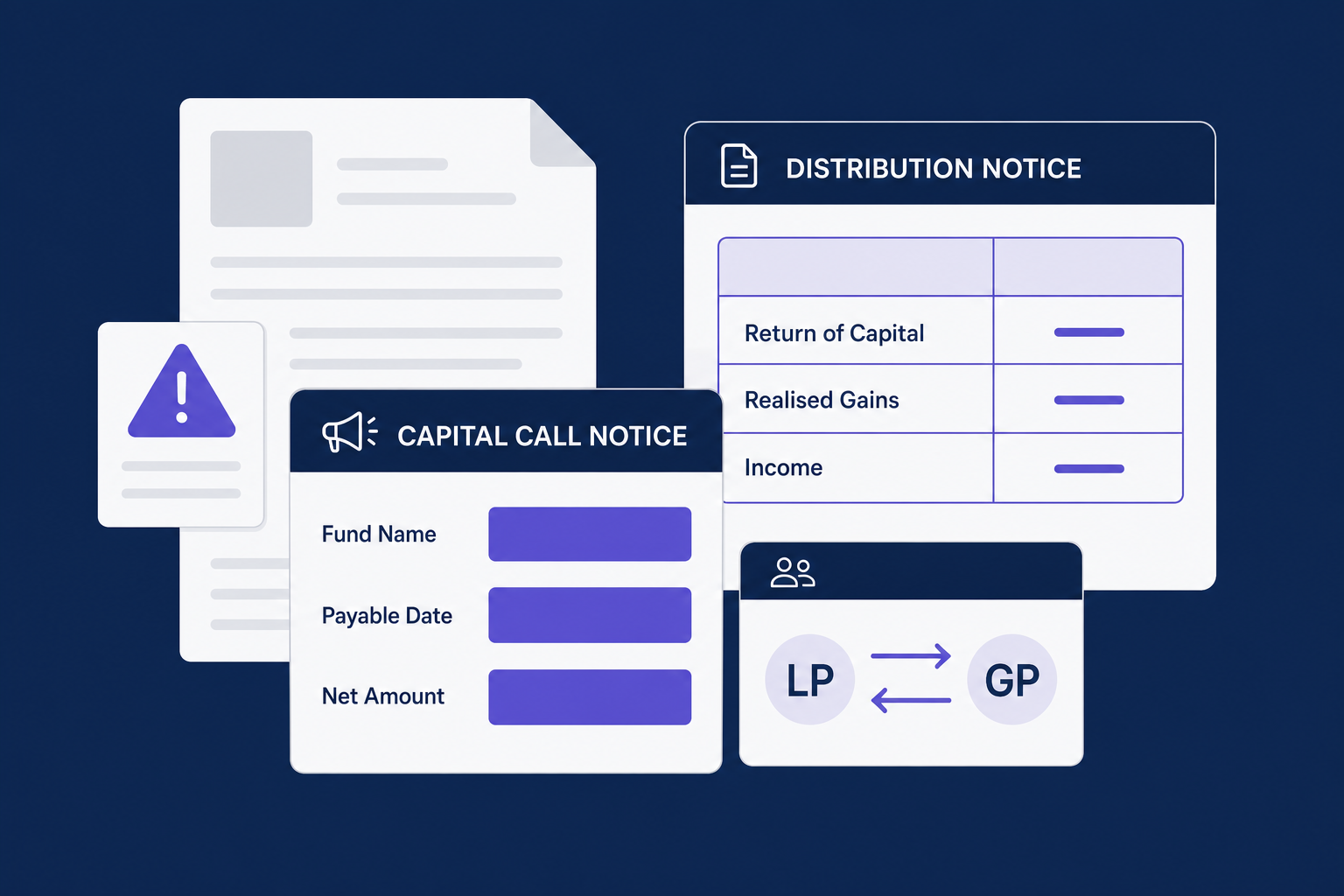
A call notice is a formal request from the GP for LPs to contribute capital.
Calls are typically made to:
-
Fund new investments during the investment period (usually the first five years of a fund's life)
-
Support follow-on investments in existing portfolio companies
-
Cover management fees and fund operating expenses
Each call reduces the LP's unfunded commitment — the capital pledged but not yet drawn. For example, an unfunded commitment of $1,000,000 reduced by a $200,000 call leaves $800,000 remaining. Calls may be classified as in-commitment (reducing unfunded) or out-of-commitment (not reducing unfunded), and the notice will typically specify which applies.
Distribution Notices
A distribution notice notifies LPs of a payment they will receive from the fund.
Distributions arise from:
-
Income generated by portfolio investments (dividends, interest)
-
Proceeds from partial or full exits
Distributions are typically broken down into components: return of capital, realised gains, and income. This breakdown matters — it affects LP-level accounting, tax treatment, and performance calculations. Some distributions are classified as recallable under the fund's LPA, meaning they increase the LP's unfunded commitment and can be drawn again by the GP in the future.
Simultaneous Notices
GPs occasionally issue a combined notice — one that nets a call and a distribution against each other. For instance, this may happen if a GP releases proceeds from an exit while at the same time calling for management fees. The net result is either a net call or a net distribution, depending on which component is larger.
What's in a Notice: Key Fields
|
Field |
Description |
|
Fund name |
Identifies the issuing fund |
|
LP name |
Confirms the notice is addressed to the correct LP entity |
|
Issue date |
Date the notice was sent by the GP |
|
Payable date |
Deadline for payment (call) or expected receipt date (distribution) |
|
Net amount |
Total amount due or receivable |
|
Breakdown of call |
Split: investments vs. management fees vs. expenses; in/out of commitment |
|
Breakdown of distribution |
Split: return of capital vs. realised gains vs. income; recallable/non-recallable |
|
Updated unfunded commitment |
Commitment balance after the notice is settled |
|
Commentary |
Context on the transaction (new investment, exit, etc.) |
|
Payment / bank details |
Wiring instructions (distributions) or GP account (calls) |
Not every notice will include all of these fields. Commentary in particular varies significantly by GP — some provide detailed investment narratives; others send bare-bones notices with minimal context.
Reconciling Notices
Once a notice is received and actioned, LP teams need to reconcile it against several independent sources to confirm accuracy:
-
Cash vs. bank statement: confirm that the amount wired (for a call) or received (for a distribution) matches the net amount stated in the notice. Timing differences of one to two business days are normal; larger discrepancies require follow-up with the GP.
-
Itemised amounts vs. LPA: validate that the breakdown of the call — investments, management fees, expenses — is consistent with the fee schedule and expense allocation policy in the Limited Partnership Agreement. Fee overcharges and incorrect expense allocations are more common than the industry acknowledges.
-
Splits and commitment impact: verify that the in-commitment / out-of-commitment classification is correct, and that the impact on unfunded commitment matches what the LPA specifies. For distributions, confirm the recallable / non-recallable classification and its effect on unfunded commitment.
-
Unfunded commitment vs. prior records: cross-check the updated unfunded commitment stated in the notice against your own internal tracker. If the figures diverge — even by a small amount — the source of the discrepancy should be identified and resolved before the next notice arrives, as errors compound over time.
For a deeper dive on Notices see: Capital Call & Distribution Notices: What LPs Need to Extract
Capital Account Statements (CAS)
If notices are the transaction alerts, the Capital Account Statement is the balance sheet. Issued quarterly (typically with a 45–90 day lag), the CAS provides a snapshot of each LP's position in the fund at a specific point in time.
Unlike a notice, which records a single event, the CAS is cumulative — it reflects everything that has happened in the fund since inception, rolled up to the current reporting date. It is the primary document for tracking an LP's financial position across the fund's life.
What's in a CAS: Key Fields
|
Field |
Description |
Notes |
|
Commitment |
Total capital pledged by the LP to the fund |
Set at inception; doesn't change unless amended |
|
Total called (contributions) |
Cumulative capital drawn by the GP to date |
Sum of all in-commitment calls received |
|
Unfunded commitment |
Capital remaining to be called (commitment minus called) |
Reduced by calls; increased by recallable distributions |
|
Total distributed |
Cumulative capital returned to the LP to date |
Sum of all distributions received |
|
Residual NAV |
Current fair market value of the LP's stake in the fund |
Provided by GP; updated quarterly |
|
Performance metrics (TVPI, DPI, IRR) |
Fund-level and LP-level return metrics |
Varies by GP — not always included at LP level |
Reconciling the CAS
The CAS is the primary reconciliation document in LP operations. Every quarter, finance and accounting teams should validate two things:
-
Inception-to-date values vs. notice history: the total called capital and total distributions shown in the CAS should match the sum of all call and distribution notices received since fund inception. Any gap — however small — indicates a notice that was missed, misclassified, or recorded differently by the GP and the LP. Similarly, the unfunded commitment shown in the CAS should reconcile to the LP's own tracker, with consistent application of recallable distribution logic and out-of-commitment call classification.
-
NAV movement vs. prior period: the residual NAV in the current CAS should equal the prior quarter NAV adjusted for the period's capital activity, unrealised gains or losses, and any distributions. Significant unexplained movements warrant cross-referencing against the QR narrative and, where available, public comparables.
For a deeper dive on CAS see: Capital Account Statements: How to Read and Reconcile Them.
Quarterly Reports (QRs)
Quarterly Reports are the most information-rich document in the LP's reporting stack — and the most time-consuming to process. They tell the story of what the fund is doing, what it owns, how it's performing, and where the capital is deployed.
For investment teams, QRs are the primary source of look-through data: the exposure-level visibility into what the fund owns, at what valuation, and with what underlying financial characteristics. For LPs managing large, diversified portfolios, extracting and structuring this data at scale is one of the most operationally demanding tasks in private markets.
What's in a QR: Key Sections
-
Market commentary: GP's view on the macro environment and its implications for the portfolio
-
Fund-level metrics: capital deployed, remaining dry powder, number of investments, expected hold period
-
Fund performance metrics: IRR (gross and net), TVPI, DPI, RVPI — at the fund level and sometimes broken down by vintage or strategy
-
Investment schedule: a table listing all portfolio companies with cost basis, proceeds to date, current fair value, and often sector and geography tags
-
Portfolio company write-ups: narrative sections covering recent developments, financial highlights, and strategic updates for each underlying investment
The investment schedule is the starting point for look-through analysis — it gives LPs a map of where their capital is deployed across sectors, geographies, and strategies. But it isn't standardised: every GP formats it differently, uses different terminology, and classifies sectors and geographies according to their own taxonomy. Normalising this data across a multi-GP portfolio is a significant operational challenge.
For a deeper dive on QR see: Quarterly Reports: What Investment Teams Need to Extract.
Financial Statements (FS)
Financial Statements provide the most formal and comprehensive view of the fund's financial position. Where the QR is a management report — narrative, performance-oriented, and produced by the GP — the FS is an accounting document, typically prepared or audited by a third party and governed by accounting standards (US GAAP or IFRS, depending on jurisdiction).
For LPs, the FS serves a different purpose than the QR. It is less useful for monitoring deal activity or look-through exposure, and more relevant for validating valuations, assessing fund-level liabilities, and supporting LP-level audit and compliance processes.
What's in an FS: Key Components
|
Component |
What It Shows |
LP Use Case |
|
Statement of Assets & Liabilities |
Fund assets (portfolio companies, cash, receivables) and liabilities (payables, debt) |
Validate NAV; assess leverage and fund-level liabilities |
|
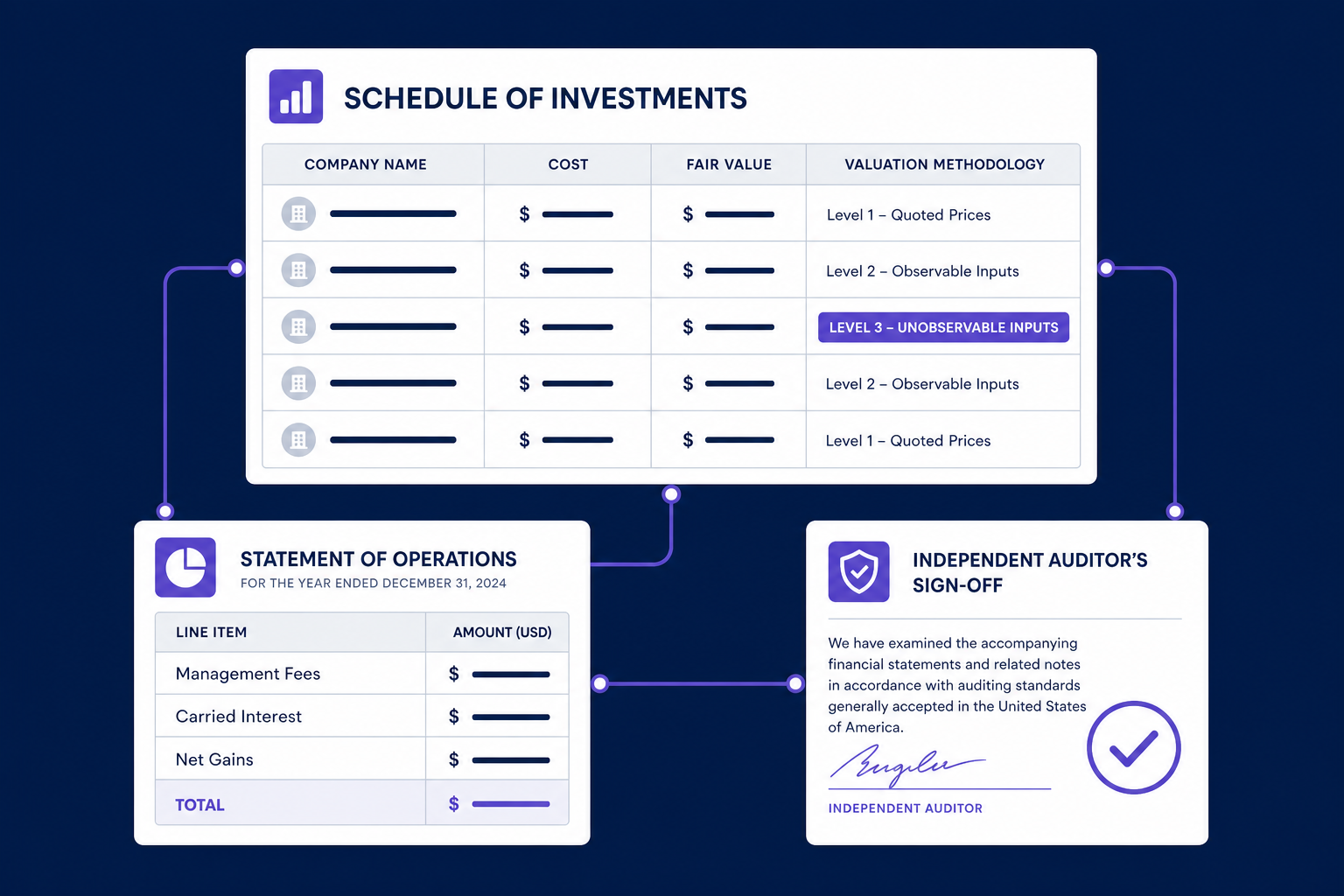
Schedule of Investments |
Detailed list of portfolio companies with cost and fair value; often includes valuation methodology notes |
Look-through; NAV validation; valuation review |
|
Statement of Operations |
Income and expenses: dividends, interest, management fees, carried interest accruals, realised and unrealised gains/losses |
Fee validation; performance attribution |
|
Statement of Changes in Partners' Capital |
Movement in LP capital accounts over the period: contributions, distributions, income allocation |
Cross-reference against CAS; reconciliation |
|
Statement of Cash Flows |
Actual cash movements in and out of the fund during the period, split into: operating activities (fee payments, working capital movements, FX effects), and investing activities (capital deployed into investments, proceeds from disposals, income distributions received). Reconciles to closing cash and cash equivalents held at fund level. |
Reconcile distributions received against fund-level cash outflows; validate that capital calls are reflected in investing activity; cross-check closing cash against balance sheet |
|
Notes to Financial Statements |
Accounting policies, fee structures, related party transactions, commitments and contingencies |
Fee audit; side letter compliance; governance |
The Schedule of Investments within the FS is particularly valuable for LPs conducting NAV validation or look-through analysis, as it often includes more detailed valuation methodology disclosures than the equivalent section in the QR. However, the FS typically arrives with a longer lag — annual audited statements may not be available until 90–120 days after the fiscal year end.
For a deeper dive on FS see: Financial Statements from GPs: What LPs Need to Review.
Who Uses What: An LP Team Perspective
One of the most common sources of friction in LP document workflows is that different teams need different information from the same documents — but often receive the raw documents in bulk, without any routing logic. The result is that operations teams wade through QR narratives they don't need, while investment teams ignore the payment details they shouldn't.
The table below maps each document type to the teams most likely to use it and for what purpose:
|
Document |
Operations Team |
Investment Team |
Accounting / Finance |
|
Notices |
Primary — pay calls, receive distributions |
Primary — monitor deal activity |
Primary — reconcile, allocate |
|
CAS |
Primary — track positions, unfunded |
Secondary — reference only |
Primary — NAV, exposure metrics |
|
QR |
Primary — extract look-through information |
Primary — performance, look-through |
Secondary — valuation inputs |
|
FS |
Secondary |
Secondary — valuation, leverage |
Primary — audit, compliance |
Understanding this distribution is the first step toward building more efficient workflows — whether that means routing documents to the right team automatically, defining a clear data extraction schema by document type, or implementing role-based access in your data systems.
Why Processing GP Documents at Scale Is Harder Than It Looks
For LPs with a small number of fund commitments, manual document processing is manageable. But as portfolios grow — to 20, 30, 50 or more fund relationships — the operational burden compounds quickly. Several structural challenges make automation non-trivial:
Siloed sources
GP documents don't arrive in one place. They are scattered across dozens of GP portals, investor relations platforms, email inboxes, and data rooms — each requiring a separate login, each with its own document naming convention, and each releasing documents on its own schedule. For an LP with 30 fund commitments, that means maintaining access to 30 separate portals and monitoring all of them across every reporting cycle. The collection problem is as significant as the extraction problem. For a deeper treatment of how LPs manage GP document collection at scale, see: Why Automating GP Document Collection Is Harder Than It Looks.
No standard format
There is no universal template for any of the four document types. Organisations such as ILPA and Invest Europe have published guidance, but adoption is inconsistent. In practice, every GP produces documents in their own format — meaning every document requires a bespoke extraction approach.
Inconsistency over time
GPs change their templates. A field that appeared in column 3 of the investment schedule last quarter may move to column 5 this quarter. A company reported as 'Alpha Holdings LLC' in Q1 may become 'Alpha Technologies' in Q2. Tracking exposures reliably over time requires entity resolution logic on top of basic extraction.
Format variety
Documents arrive as PDFs, Excel files, LPAC decks, and occasionally in portal-based formats. Within a single PDF, tables may be selectable text or embedded images. Footnotes may contain material data. OCR tools can handle some of this, but break on complex layouts or non-standard fonts.
Volume
A portfolio of 30 fund commitments generates approximately 120 QRs per year, 120 CAS, 60–100 notices, and 30–60 FS. That's 330–410 documents per year — each requiring data extraction, validation, and reconciliation against internal records. For most LP operations teams, this is the single largest source of manual overhead.
Getting Started: A Framework for LP Document Management
Building a scalable document management workflow starts with three decisions:
-
Define your data schema: which fields do you need from each document type, for which use cases?
-
Assign ownership: which team owns each document type, and what are their output requirements?
-
Choose your extraction approach: manual, OCR, general-purpose AI, or a purpose-built private markets platform?
The articles in this series go deeper on each document type — covering field-by-field extraction guidance, common data quality issues, and how to structure the data for downstream use. Start with the document type most relevant to your current bottleneck:
FAQ
What is a capital call notice in private equity?
A capital call notice is a formal document issued by a General Partner (GP) requesting Limited Partners (LPs) to contribute a specified amount of capital to the fund. Calls are typically made to fund new investments, support existing portfolio companies, or cover management fees and expenses. They arrive unpredictably throughout a fund's life — most frequently during the investment period (typically the first five years) — and include a payable date by which the LP must wire the funds.
What is a Capital Account Statement (CAS) in a private fund?
A Capital Account Statement is a quarterly document issued by a GP that provides each LP with a snapshot of their individual financial position in the fund at a specific point in time. It shows total capital committed, total capital called to date, unfunded commitment remaining, total distributions received, and the current NAV of the LP's stake. It is the primary document used by LP accounting teams for reconciliation and position tracking.
What is the difference between a Quarterly Report and a Financial Statement in private equity?
A Quarterly Report (QR) is a management report produced by the GP covering fund performance, portfolio company updates, deal activity, and look-through data. It is the primary document for investment teams monitoring portfolio exposure. A Financial Statement (FS) is a formal accounting document — typically audited — covering the fund's balance sheet, income statement, and detailed schedule of investments. It is primarily used by accounting, finance, and audit teams for valuation validation, fee review, and compliance.
What is a Statement of Cash Flows in a private equity fund financial statement?
The Statement of Cash Flows shows actual cash movements in and out of the fund during the reporting period, split into operating activities (fee payments, working capital movements, FX effects on cash) and investing activities (capital deployed into portfolio companies, proceeds from disposals, income distributions received from investments). It reconciles to the closing cash and cash equivalents held at fund level. For LPs, it is useful for cross-checking that distributions received match fund-level cash outflows, and that capital calls are correctly reflected in the fund's investing activity.
How many documents does an LP receive from GPs each year?
For a portfolio with 30 fund commitments, an LP can expect to receive approximately 120 quarterly reports, 120 capital account statements, 60–180 notices (calls and distributions), and 30–60 financial statements per year — totalling 330–480 documents annually. Volume scales linearly with portfolio size, which is why document processing automation becomes critical as portfolios grow.
What is the ILPA reporting template for LP notices?
The Institutional Limited Partners Association (ILPA) has published standardised templates for capital call and distribution notices, designed to improve consistency and comparability across GPs. The ILPA notice template includes standardised fields for fund details, LP details, payable dates, net amounts, call and distribution breakdowns, unfunded commitment impacts, and payment instructions. Adoption of the ILPA template is growing, particularly among larger institutional GPs, but is not universal. Invest Europe has published equivalent guidance for European managers.
Why is it hard to automate GP document processing?
GP document processing is difficult to automate for three main reasons. First, there is no universal format: every GP produces notices, CAS, QRs, and FS in their own template, meaning every document requires a bespoke extraction approach. Second, GPs change their templates over time, breaking rule-based extraction logic. Third, documents arrive in varied formats — PDFs (including image-based PDFs), Excel files, and portal exports — with material data often buried in footnotes or narrative sections. Purpose-built private markets AI platforms address these challenges by combining document-type-specific extraction models with human-in-the-loop validation workflows.
What is look-through analysis in private equity?
Look-through analysis is the process by which LPs extract and analyse data on the underlying portfolio companies held by their GP-managed funds. Rather than monitoring investments at the fund level only, look-through gives LPs visibility into individual company exposures — sector, geography, valuation, financial metrics — across their entire portfolio of fund commitments. The primary source of look-through data is the investment schedule and company write-ups contained in quarterly reports (QRs) and financial statements (FS).