Capital Account Statements in Private Equity: How LPs Read, Use, and Reconcile Them
What a CAS contains, how it differs from notices and quarterly reports, and how to build a reliable reconciliation workflow.
For most LP organisations, the Capital Account Statement (CAS) is the document that keeps everything honest. Notices tell you what happened — a call was issued, a distribution was paid. Quarterly reports tell you how the portfolio is performing. But the CAS is the document that tells you where you actually stand: how much capital has been drawn, how much has come back, what your current NAV is, and how much remains to be called.
It is also the primary reconciliation document. Every quarter, LP accounting and finance teams compare the CAS against their own internal records to verify that every call and distribution has been captured correctly, that unfunded commitment is tracking properly, and that the NAV figure is consistent with prior period movements. For portfolios spanning 20 or more fund commitments, this reconciliation exercise is one of the most time-intensive recurring tasks in LP operations.
This guide covers what a CAS contains, how it fits into the broader reporting stack, how different LP teams use it, the most common reconciliation challenges — including the edge cases that consistently cause discrepancies — and what a robust CAS management framework looks like.
This article is part of the Tamarix series on GP fund documents. For an overview of all four document types LPs receive, start with The LP's Guide to GP Fund Documents.
How the CAS Fits Into the LP Reporting Stack
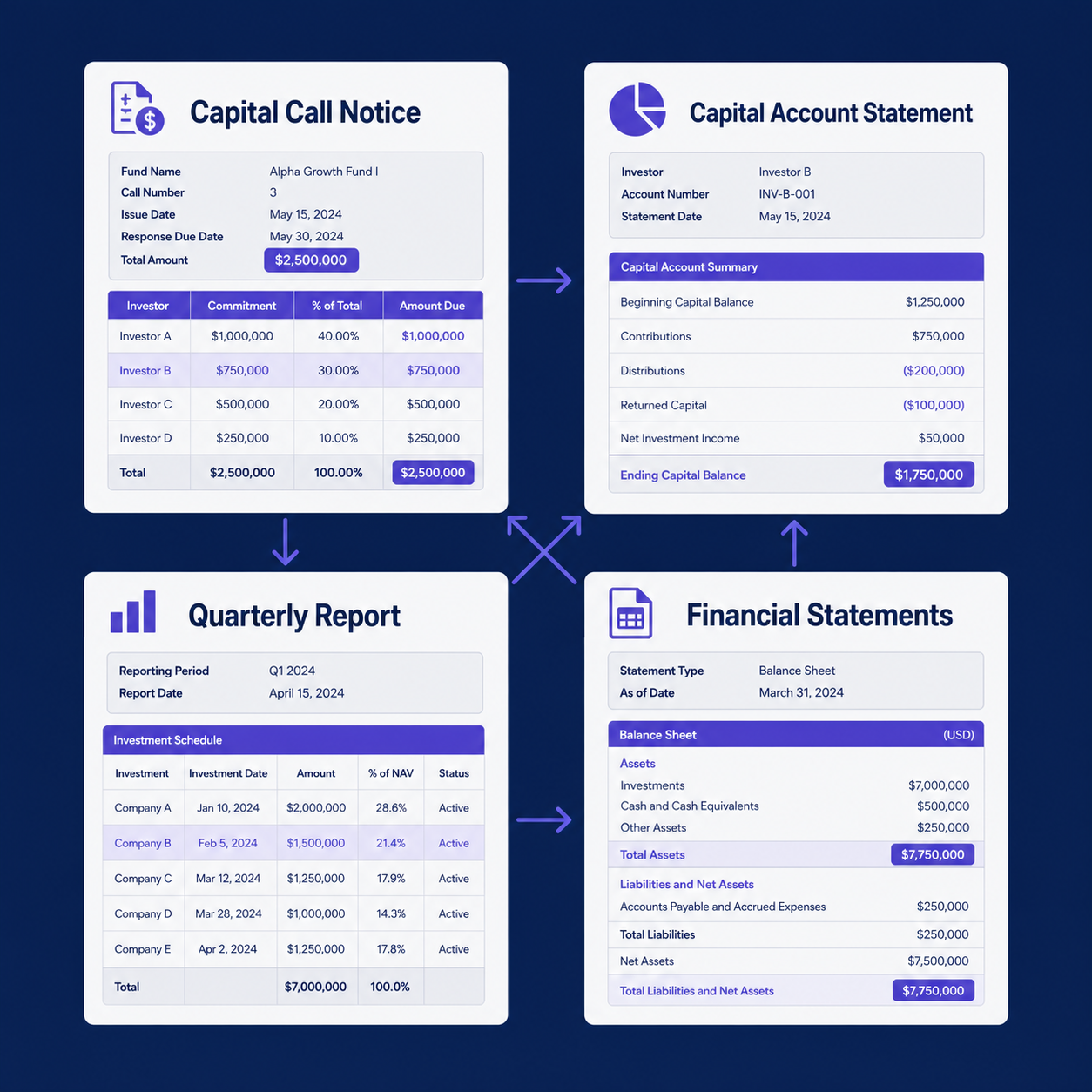
The CAS occupies a specific and important position in the GP reporting ecosystem. To understand what it does, it helps to contrast it with the other documents an LP receives:
|
|
Notices |
CAS |
QR / FS |
|
What it covers |
Single transaction event |
Cumulative LP position to date |
Fund performance & portfolio detail |
|
Time horizon |
Point in time (one event) |
Inception-to-date, updated quarterly |
Quarterly snapshot |
|
Primary audience |
Operations, Accounting |
Accounting, Finance |
Investment Team, CIO |
|
Frequency |
As needed (event-driven) |
Quarterly (45–90 day lag) |
Quarterly (45–90 day lag) |
|
Core use case |
Trigger payments, reconcile cash |
Track position, validate NAV, reconcile |
Monitor performance, look-through analysis |
The key distinction is time horizon. A notice records a single event — one call, one distribution — at a point in time. The CAS is cumulative: it aggregates every capital movement since fund inception into a single statement of the LP's current position. Every notice an LP has ever received from a given fund should be visible — in some form — in the CAS totals.
This is what makes the CAS the reconciliation anchor. If the cumulative called capital in the CAS doesn't match the sum of call notices in the LP's records, something is wrong — either a notice was missed, misclassified, or recorded differently by the GP and the LP. The CAS surfaces that discrepancy; it doesn't explain it. Resolving it requires going back to the underlying notices and, in some cases, the LPA.
What's in a Capital Account Statement: Field-by-Field Guide
CAS formats vary by GP — there is no universal template, though ILPA has published guidance — but the core fields are consistent across most institutional-quality reports. Below is a field-by-field breakdown of what to expect and what each field means for LP workflows.
|
Field |
What It Shows |
Notes |
|
Commitment |
Total capital pledged by the LP to the fund at close |
Fixed at inception; only changes if LP transfers interest or commitment is amended |
|
Total contributions (called capital) |
Cumulative capital drawn by the GP from the LP to date |
Sum of all in-commitment calls received since fund inception |
|
Unfunded commitment |
Capital remaining to be called (commitment minus called) |
Reduced by in-commitment calls; increased by recallable distributions; may differ from your own records if tracking logic differs |
|
Total distributions |
Cumulative capital returned to the LP to date |
Sum of all distributions received; may be split into return of capital, realised gains, and income |
|
Residual NAV |
Current fair market value of the LP's stake in the fund |
GP-provided mark; updated quarterly; basis for TVPI calculation |
|
TVPI / DPI / RVPI |
Fund-level and LP-level return multiples |
Not always included at LP level; more commonly reported at fund level in the QR |
|
Management fees paid |
Cumulative fees drawn from the LP's capital account |
Useful for fee reconciliation against LPA terms and side letter provisions |
|
Carried interest accrued |
Estimated carry accrual against the LP's account |
Indicative only; actual carry determined at fund level per waterfall mechanics |
|
Equalisation entries |
Adjustments for new LP closings, fee offsets, or prior period corrections |
Common in multi-close funds — see dedicated article [LINK TO EQUALISATION SPOKE] |
|
Period activity |
Capital movements during the current quarter: calls received, distributions paid, NAV change |
Bridges the prior period CAS to the current one; useful for quarter-on-quarter reconciliation |
A note on period activity vs. inception-to-date: Most CAS reports present both a 'current quarter' activity column and an 'inception-to-date' cumulative column. The inception-to-date figures are the reconciliation anchor; the current quarter figures are useful for validating that the most recent notices have been correctly incorporated. Always check both.
How Different LP Teams Use the CAS
Accounting and Finance: The Primary Owner
The CAS is primarily an accounting document. The finance team owns it — using it to maintain accurate position records for each fund commitment, update NAV schedules, calculate performance metrics, and support LP-level financial statement preparation.
On a quarterly basis, the accounting workflow typically runs as follows: receive CAS from GP → compare called capital and distributions against internal ledger → reconcile unfunded commitment → update NAV → flag any discrepancies for resolution with the GP. For portfolios with many fund commitments, this workflow repeats across every fund in the same 2–3 week window after quarter end.
The CAS is also the primary input for LP-level TVPI and DPI calculations. If the residual NAV or distribution figures in the CAS differ from the LP's own records — even by small amounts — the performance metrics will diverge, creating inconsistencies across reporting periods.
Operations: Unfunded Commitment Tracking
Operations teams use the CAS primarily to maintain an accurate unfunded commitment schedule — the forward-looking view of how much capital can still be called by each GP. This is critical for liquidity planning: LPs need to know, at any given time, how much cash may be required by their fund portfolio in the coming 12–24 months.
The unfunded commitment figure in the CAS is the GP's view of what remains callable. It should reconcile to the LP's own tracker, but discrepancies arise — particularly around recallable distributions, out-of-commitment calls, and LPA-specific provisions. Operations teams should treat the CAS figure as a checkpoint against their own records, not as the sole source of truth.
Investment Team: Exposure and Performance Monitoring
For investment teams, the CAS is primarily a source of fund-level exposure and performance data. Each quarter, the CAS provides an up-to-date picture of how much capital is deployed in each fund, how much has been returned, what the current NAV is, and what the return multiples look like — the inputs needed to understand how individual commitments are shaping up within the broader portfolio.
Aggregated across all fund commitments, this data allows investment teams to track how total deployed capital, distributions, and unrealised value are evolving over time — and to flag any funds where NAV movements or distribution pace are diverging from expectations. The CAS won't tell you why a fund is under- or over-performing — for that, you need the QR — but it tells you which ones to look at more closely.
Reconciling the CAS: A Practical Framework
Reconciliation is the core operational task associated with the CAS. The goal is to verify that the GP's view of the LP's position matches the LP's own records — for every field that matters. In practice, most LP teams reconcile at minimum four key metrics: called capital, distributions, unfunded commitment, and NAV.
|
Reconciliation Check |
CAS Field |
Cross-Reference Against |
Common Discrepancy |
|
Called matches |
Total contributions |
Sum of all call notices received |
Out-of-commitment calls excluded from some LP records |
|
Distributions match |
Total distributions |
Sum of all distribution notices received + bank statements |
Recallable distributions recorded differently by LP vs GP |
|
Unfunded matches |
Unfunded commitment |
LP's own commitment tracker |
Recallable distribution logic applied inconsistently |
|
NAV is current |
Residual NAV |
Prior quarter NAV + current quarter activity |
Stale marks; GP using different valuation date |
The Most Common Sources of Discrepancy
Recallable distribution logic
This is the single most frequent source of unfunded commitment discrepancy. When a GP classifies a distribution as recallable, the LP's unfunded commitment should increase by the recallable amount. If the LP's internal system doesn't automatically apply this logic — or applies it differently from the GP — the unfunded commitment figures will diverge. The discrepancy compounds over time as more recallable distributions accumulate.
Out-of-commitment call classification
Out-of-commitment calls do not reduce unfunded commitment. If an LP's system automatically reduces unfunded commitment for every call received — regardless of classification — it will understate unfunded commitment over time. The classification should always be checked against the notice before updating the tracker.
Timing differences
CAS figures are typically as of the last day of the quarter. Bank statements may show cash movements on slightly different dates due to wiring lag. Notices may have been issued in one quarter but settled in the next. These timing differences are usually benign — but they need to be identified and documented rather than left as unexplained gaps.
Equalisation entries
In multi-close funds, equalisation entries adjust the LP's capital account to reflect their late entry into the fund. They often appear as large one-time contributions or distributions with no corresponding notice — which is why they are a persistent source of reconciliation confusion. For a full explanation of how equalisation works across both notices and the CAS, see our dedicated guide: Equalisation in Private Equity Funds: What LPs Need to Know.
Fee offset adjustments
Many LPs negotiate management fee offsets or fee caps in their side letters. When these provisions apply, the GP adjusts the CAS accordingly — sometimes reducing called capital, sometimes increasing distributions. If the LP's internal records don't reflect the same offset logic, the CAS and internal figures will diverge.
Using the CAS for NAV Validation
The residual NAV figure in the CAS is the GP's mark on the LP's current stake in the fund. It is updated quarterly and is the basis for TVPI calculations (Total Value to Paid-In = (Distributions + Residual NAV) / Called Capital).
For LP accounting teams, NAV validation involves two checks. The first is mechanical: does the current quarter NAV equal the prior quarter NAV, plus the current quarter unrealised gain/loss, plus any new investments, minus any realisations? This can be verified from the period activity section of the CAS.
The second check is more judgemental: does the NAV level seem reasonable given what the investment team knows about portfolio performance? Significant quarter-on-quarter NAV movements — particularly mark-ups — should be cross-referenced against the QR narrative and, where possible, public comparables. The CAS flags the number; the QR provides the context.
For LP teams conducting NAV validation, the Financial Statements provide the deeper valuation methodology disclosures needed to assess mark quality. See: Financial Statements from GPs — What LPs Need to Review.
Processing CAS Documents at Scale: The Core Challenges
Format inconsistency across GPs
There is no universal CAS format. ILPA has published a standardised template, but adoption varies widely. In practice, GPs produce CAS documents in proprietary formats — some in PDF, some in Excel, some embedded within broader fund reporting packages. Field labels differ: what one GP calls 'unfunded commitment' another calls 'remaining commitment' or 'uncalled capital.' The underlying concept is the same; the label is not, which makes automated extraction and cross-portfolio aggregation harder than it should be.
Lagged delivery
CAS documents typically arrive 45–90 days after quarter end — the same lag as QRs and FS. For LP teams trying to maintain a current view of their portfolio positions, this lag means the CAS is always a quarter behind. Some GPs provide preliminary estimates on request, but this is not standard practice. LPs should maintain their own interim position tracker — updated from notices as they arrive — rather than waiting for the CAS to update their records.
Reconciliation at scale
For a portfolio of 30 fund commitments, quarterly CAS reconciliation means 30 separate reconciliation checks, each involving multiple fields, each potentially requiring follow-up with the GP. In the absence of automation, this is typically a 2–3 week exercise per quarter for a small team. Errors accumulate if reconciliation is done under time pressure — small discrepancies that are not resolved promptly tend to compound into larger ones over subsequent quarters.
Next Steps
The CAS gives you the position view — but the story behind the numbers lives in the Quarterly Report. The QR tells you what the fund actually owns, how each portfolio company is performing, and whether the GP is executing on their stated strategy. For investment teams, it is the primary source of look-through data.
How Tamarix helps: Tamarix extracts structured data from CAS documents — regardless of GP format — and automatically reconciles extracted figures against prior period records and notice history. Unfunded commitment logic (including recallable distributions and out-of-commitment calls) is applied consistently across all funds, and discrepancies are surfaced in an exception queue for review. Book a call to learn more.
FAQ
What is a Capital Account Statement in private equity?
A Capital Account Statement (CAS) is a quarterly document issued by a General Partner (GP) that provides each Limited Partner (LP) with a snapshot of their individual financial position in the fund at a specific point in time. It shows total capital committed, cumulative capital called to date, unfunded commitment remaining, total distributions received to date, and the current fair market value (NAV) of the LP's stake in the fund. It is the primary document used by LP accounting and finance teams for position tracking and reconciliation.
What is the difference between a Capital Account Statement and a capital call notice?
A capital call notice records a single transaction — one specific request by the GP for the LP to contribute capital. A Capital Account Statement is cumulative — it aggregates every capital movement since fund inception (all calls, all distributions, NAV changes) into a single statement of the LP's current position. The CAS is issued quarterly; notices are issued on an event-driven basis whenever a capital movement occurs. Every notice should ultimately be reflected in the CAS totals.
What is unfunded commitment in a Capital Account Statement?
Unfunded commitment is the portion of an LP's total capital commitment that has not yet been drawn by the GP. In the CAS, it is calculated as total commitment minus total capital called (in-commitment calls only). It is reduced each time the GP issues an in-commitment capital call, and increased when the GP issues a recallable distribution. The unfunded commitment figure in the CAS represents the GP's view of remaining callable capital — it should be reconciled against the LP's own commitment tracker each quarter.
How often is a Capital Account Statement issued?
Capital Account Statements are typically issued quarterly, with a reporting lag of 45 to 90 days after the end of each quarter. This means an LP receiving a Q1 CAS (January–March) would typically receive it between mid-May and late June. Some GPs issue annual CAS only, though quarterly issuance is the institutional standard. The CAS lag is the same as the Quarterly Report and Financial Statements — all three tend to arrive in the same reporting package.
What is the TVPI in a Capital Account Statement?
TVPI (Total Value to Paid-In) is a return multiple that measures the total value generated by a fund relative to the capital invested. It is calculated as: (Total Distributions + Residual NAV) / Total Called Capital. In the CAS, the residual NAV and distribution figures are the inputs to this calculation. TVPI is sometimes reported directly in the CAS, but is more commonly found in the Quarterly Report. An LP can calculate their own LP-level TVPI from CAS data if the GP does not provide it directly.
What is the difference between a Capital Account Statement and a Quarterly Report?
A Capital Account Statement is an LP-specific document showing that individual LP's financial position in the fund: their commitment, called capital, distributions received, unfunded commitment, and NAV. It does not contain information about other LPs or the fund's underlying portfolio companies. A Quarterly Report is a fund-level document covering all LPs collectively — it reports on fund performance, portfolio company activity, and investment-level data. The CAS is the accounting document; the QR is the performance and monitoring document.
Why does my unfunded commitment differ from what the GP shows in the CAS?
Unfunded commitment discrepancies between LP records and the GP's CAS are common and typically arise from four sources. First, recallable distributions: if the LP's system doesn't automatically increase unfunded commitment when a recallable distribution is received, it will understate the figure over time. Second, out-of-commitment calls: calls classified as out-of-commitment should not reduce unfunded commitment, but some LP systems reduce it automatically for all calls. Third, equalisation entries in multi-close funds — for a full treatment of this, see Equalisation in Private Equity Funds. Fourth, timing differences between when a notice was issued and when it was recorded.Equalisation in Private Equity Funds
How should LPs reconcile their Capital Account Statement?
A robust CAS reconciliation workflow covers six checks: (1) verify that total called capital matches the sum of all in-commitment call notices received; (2) verify that total distributions match the sum of all distribution notices received and bank statements; (3) confirm the unfunded commitment figure matches the LP's own tracker, with recallable distribution and out-of-commitment call logic applied consistently; (4) validate the current quarter NAV by checking it against the prior quarter NAV plus period activity; (5) confirm management fees match the LPA fee schedule and any side letter provisions; (6) verify that current quarter cash movements match bank statement entries. Discrepancies in any of these should be documented and resolved with the GP before the next reporting period.