Call & Distribution Notices in Private Equity: A Complete LP Guide
What they are, what they contain, how different LP teams use them — and why processing them at scale is harder than it looks.
Of all the documents a Limited Partner (LP) receives from General Partners (GPs), capital call and distribution notices are the most operationally critical. A missed call deadline triggers penalties. A distribution received but not reconciled creates accounting breaks. And for portfolios spanning 20 or more fund commitments, the volume — 30 to 60 notices per fund over its lifetime — adds up fast.
Yet notices are also among the least standardised documents in private markets. Every GP produces them differently. Some follow ILPA templates; most don't. Fields appear in different places, use different labels, and carry different levels of commentary. For LP teams trying to automate or scale their notice workflows, this inconsistency is the central challenge.
This guide covers everything an LP needs to know about GP notices: how they work, what they contain, how different teams within an LP organisation use them, and what a robust data collection framework looks like. It draws on the anatomy of both call and distribution notices, including the edge cases — simultaneous notices, out-of-commitment calls, recallable distributions — that tend to trip up manual workflows.
This article is part of the Tamarix series on GP fund documents. For an overview of all four document types LPs receive, start with The LP's Guide to GP Fund Documents.
How GP Notices Work: The Basics
Private market funds have a distinctive capital structure: LPs commit capital upfront but don't transfer it immediately. Instead, the GP draws down that capital over time — calling it as investments are made, fees accrue, or expenses arise — and returns it gradually as the portfolio matures and exits are executed.
Notices are the formal mechanism through which this movement of capital is communicated. Every time the GP needs capital from LPs, or returns capital to them, a notice is issued. They are not on a fixed schedule — their timing is driven entirely by fund activity — which is what makes them operationally demanding to manage.
Over a typical fund's 10–12 year life, an LP can expect to receive between 30 and 60 notices in total, though this varies significantly by strategy. A buyout fund with a concentrated portfolio might issue 20–30 notices; a private debt fund with high deal velocity and regular income distributions might issue 80 or more.
|
|
Capital Call Notice |
Distribution Notice |
|
Triggered by |
New investment, follow-on, management fee cycle, fund expenses |
Portfolio company exit, income event (dividend, interest) |
|
Direction of cash |
LP wires capital to the GP / fund |
GP wires capital to the LP |
|
Impact on unfunded commitment |
Reduces unfunded commitment (in-commitment calls) or no impact (out-of-commitment) |
No impact, unless distribution is recallable — in which case it increases unfunded |
|
Timing |
Concentrated in investment period (yrs 1–5); fees/expenses throughout fund life |
Concentrated in harvesting period (yrs 5+); income strategies from yr 1 |
|
Typical volume |
15–40 over a fund's life |
10–30 over a fund's life |
|
Operational urgency |
High — missed deadlines trigger penalties |
Medium — delayed reconciliation, not penalties |
Capital Call Notices: What LPs Need to Know
Why Calls Are Issued
GPs issue capital calls for three broad reasons:
-
New investments: funding a new portfolio company acquisition, typically during the investment period (the first five years of the fund's life)
-
Follow-on investments: additional capital into existing portfolio companies — for add-on acquisitions, growth capital, or bridge financing
-
Fees and expenses: management fees (typically 1.5–2% of committed capital per annum during the investment period) and fund operating costs such as legal fees, audit fees, and organisational expenses
Most capital calls occur during the investment period, when the GP is actively deploying capital into new deals. However, calls for management fees and expenses continue throughout the fund's life — including the harvest period — and calls for follow-on investments can arise at any point.
In-Commitment vs. Out-of-Commitment Calls
Not all calls reduce an LP's unfunded commitment equally:
-
In-commitment calls — the most common type — reduce the unfunded commitment dollar-for-dollar. An LP with $1,000,000 unfunded that receives a $200,000 in-commitment call will have $800,000 remaining.
-
Out-of-commitment calls do not reduce the unfunded commitment. These are less common and typically arise in specific situations defined by the fund's Limited Partnership Agreement (LPA). The notice will generally specify the classification, but LPs should cross-reference their LPA when the classification is unclear.
Timing and Advance Notice
Most LPA agreements require GPs to provide LPs with 5–10 business days' advance notice before a call payable date, though some funds require as few as 3 days. This window is tight — particularly for larger LPs who need to liquidate assets or move capital across accounts before wiring. Missing the payable date can result in interest charges on the overdue amount (typically at a default rate specified in the LPA) or, in severe cases, LP default provisions.
Distribution Notices: What LPs Need to Know
Why Distributions Are Issued
Distribution notices notify LPs of capital being returned to them. They arise from two primary sources:
-
Exit proceeds: when the GP sells a portfolio company (fully or partially), generating realised gains and return of capital
-
Income events: dividends, interest payments, or other income from portfolio investments — particularly common in private debt, infrastructure, and real estate strategies
For buyout and venture capital funds, distributions are typically concentrated in the harvest period — the second half of the fund's life — as the GP works toward exit. For income-generating strategies such as private debt, distributions may begin from year one as interest payments flow through.
Breakdown of Distribution Components
Understanding the breakdown of a distribution matters for both accounting accuracy and tax treatment. Distributions are typically split into:
-
Return of capital: the return of the LP's original invested capital — not a gain, no tax event in most jurisdictions
-
Realised gains: profit above the cost basis generated from an exit — typically a taxable event
-
Income: dividends or interest paid out of portfolio investments — taxed as income in most jurisdictions
The GP will specify this breakdown in the notice. LPs should validate that the breakdown is consistent with the fund's waterfall structure and their individual side letter provisions, as some LPs may have preferential allocations that affect how proceeds are distributed.
Recallable vs. Non-Recallable Distributions
A critical distinction that many LP teams underestimate: some distributions are classified as recallable under the fund's LPA. A recallable distribution means the GP retains the right to call that capital back in the future — for example, to fund a follow-on investment. When a recallable distribution is received, the LP's unfunded commitment increases by the recallable amount, rather than staying flat.
This is a common source of reconciliation error. LPs who treat all distributions as non-recallable will understate their unfunded commitment — potentially missing a future call or miscalculating portfolio-level liquidity needs. The notice will typically flag recallable amounts explicitly, but the definition of 'recallable' should always be confirmed against the LPA.
Simultaneous Call and Distribution Notices
GPs occasionally issue a single notice that combines both a call and a distribution — netting the two amounts against each other. This occurs most commonly when the GP is simultaneously realising an investment (generating distribution proceeds) and calling capital for fees or a new investment.
The notice will offset the call and distribution amounts, resulting in either a net call (LP wires the difference) or a net distribution (LP receives the difference). From an LP accounting perspective, the two components should still be recorded separately — as a call and a distribution — even though only one cash movement occurs.
Anatomy of a GP Notice: Field-by-Field Guide
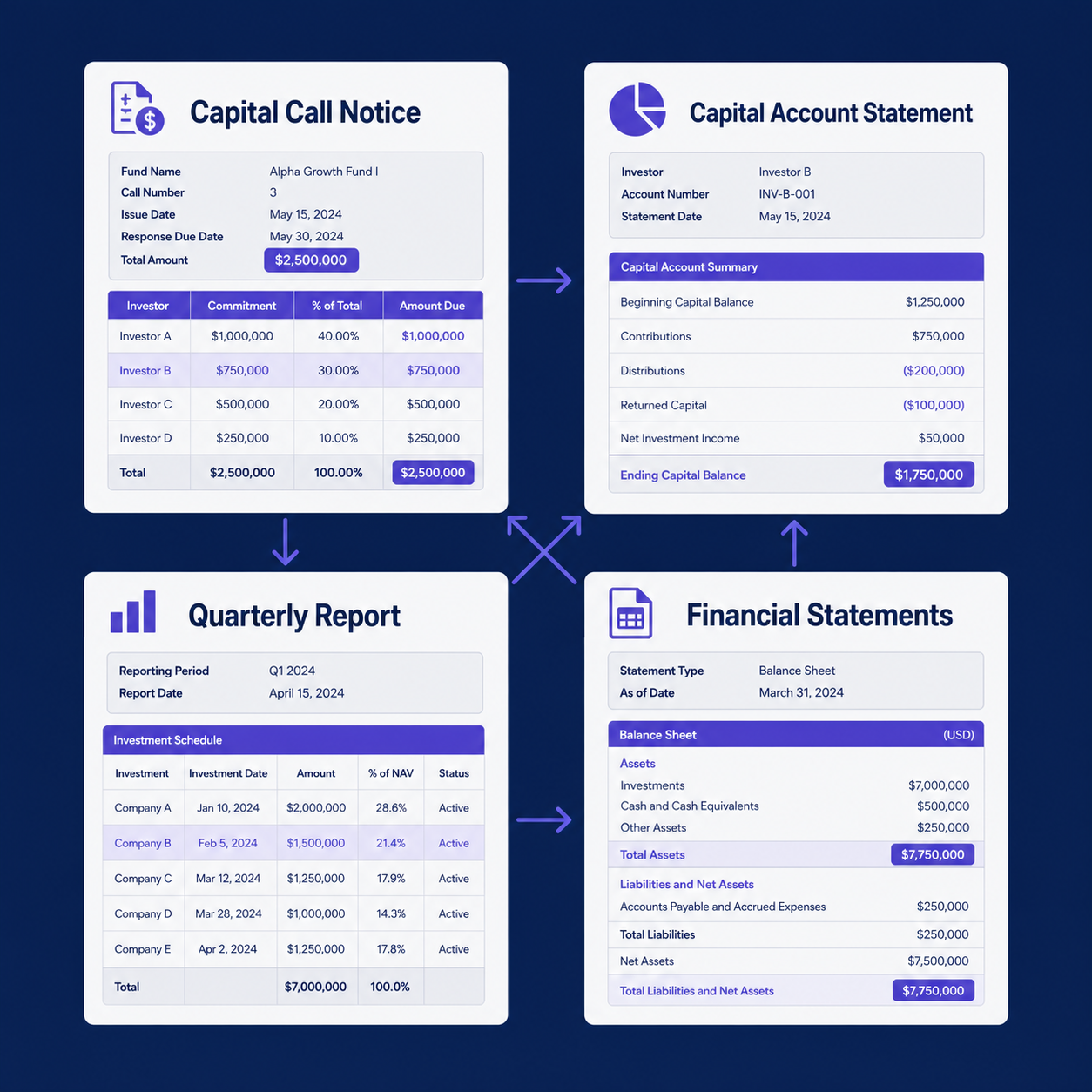
Despite the lack of a universal standard, most GP notices contain a consistent set of fields. The table below covers each one — what it contains, and whether it is typically present.
|
Field |
What It Contains |
Always Present? |
|
Fund name |
Name of the fund issuing the notice |
Yes |
|
LP name / entity |
The specific LP entity to whom the notice is addressed |
Yes |
|
Issue date |
Date the notice was generated and sent by the GP |
Yes |
|
Payable date |
Deadline for wiring (calls) or expected receipt date (distributions) |
Yes |
|
Net amount |
Total amount due from or payable to the LP |
Yes |
|
Call breakdown |
Split by purpose: investments vs. management fees vs. expenses; in-commitment vs. out-of-commitment classification |
When notice is a call |
|
Distribution breakdown |
Split by type: return of capital vs. realised gains vs. income; recallable vs. non-recallable classification |
When notice is a distribution |
|
Unfunded commitment (pre/post) |
LP's remaining capital commitment before and after the notice is settled |
Often, not always |
|
Equalisation entries |
Adjustments to reallocate prior calls/distributions when new LPs join the fund |
Multi-close funds only |
|
Commentary |
Narrative context: investment rationale, exit summary, or fee explanation |
Varies by GP |
|
Payment / bank details |
Wiring instructions for call payment; GP bank details for distribution receipt |
Yes (for payment-triggered notices) |
ILPA Standard: The Institutional Limited Partners Association (ILPA) has published a standardised notice template covering all of the fields above. Adoption is growing — particularly among larger, more institutional GPs — but is not universal. If a GP follows the ILPA template, field location and labelling will be consistent across notices. If not, field names and positions will vary from notice to notice.
How Different LP Teams Use GP Notices
One of the most important — and most overlooked — aspects of notice management is that different teams within an LP organisation need different information from the same document. Operations teams need to act quickly on payment logistics. Accounting teams need granular breakdown data for accurate allocation. Investment teams treat notices as a signal of portfolio activity.
Processing a notice effectively means routing the right fields to the right teams — not forwarding a PDF to a shared inbox and hoping everyone finds what they need.
|
Team |
Primary Focus on Notices |
Key Fields |
Main Risk if Missed |
|
Operations |
Execute payments and receipts accurately and on time |
Payable date, net amount, bank details |
Missed deadline → penalties, strained GP relationship |
|
Accounting / Finance |
Accurate allocation and reconciliation in fund records |
Call/distribution breakdown, unfunded commitment, recallable flag |
Misallocated entries, incorrect NAV, reconciliation breaks |
|
Investment Team |
Monitor deal activity and validate GP strategy execution |
Commentary, investment/exit rationale, called-for-investments amount |
Blind spots in portfolio activity, delayed performance attribution |
The Operations Team: Speed and Accuracy
For operations teams, a notice is primarily a payment instruction. The critical fields are the payable date, the net amount, and the GP's bank account details. Everything else is secondary.
The core workflow is: receive notice → validate against prior notice and LPA → initiate wire transfer → confirm receipt → log.
The most common operational failures are: missing the payable date (tight 5–10 day windows leave little buffer), wiring to an outdated bank account (GPs occasionally update banking details without sufficient advance notice), and failing to identify net notices where a call and distribution have been offset.
The Accounting Team: Precision in Allocation
Accounting teams need more from a notice than just the net amount. They need the full breakdown: how much of a call was for investments versus fees versus expenses, and whether a distribution represents return of capital, realised gains, or income. Each component flows into a different account in the fund's books.
The accounting team also owns unfunded commitment tracking — which means they need to correctly apply the in-commitment / out-of-commitment classification on calls, and the recallable / non-recallable classification on distributions. Errors here compound over time, particularly in funds with complex waterfall structures or multiple LP classes.
The Investment Team: Notices as Portfolio Signals
For investment teams, the most valuable part of a notice is often the commentary section — the narrative that explains what investment was made, what company was exited, and what the GP's rationale was. This context helps the investment team verify that the GP is executing on their stated strategy, track deal activity between formal reporting cycles, and monitor portfolio construction in real time.
Investment teams are less focused on payable dates and bank details. What they want is: what happened, why, and what does it mean for the portfolio?
Processing Notices at Scale: The Core Challenges
Volume
A portfolio of 30 fund commitments can generate 900–1,800 notices over the life of those funds — and at any given time, 30–60 notices are arriving per year. Each one requires review, validation against the LPA, data extraction, and reconciliation against the LP's internal records. For teams without automation, this is a significant recurring overhead.
Format Inconsistency
There is no universal notice format. Some GPs follow the ILPA template; most don't. Field positions, field labels, and the level of detail in breakdowns vary from GP to GP — and often from notice to notice from the same GP. GPs periodically update their templates, change their formatting, or restructure their reporting, which breaks any rule-based extraction logic built around a specific layout.
Edge Cases
The edge cases are where manual workflows most commonly fail: simultaneous call-and-distribution notices that need to be split into two separate records; out-of-commitment calls that don't reduce unfunded commitment; recallable distributions that increase it; equalisation entries in multi-close funds. These require interpretation, not just extraction — which is why general-purpose OCR tools are insufficient on their own.
Reconciliation
Every notice needs to be reconciled against two things: the LP's internal records (to confirm the amount matches what was expected based on prior notices and LPA terms) and actual bank movements (to confirm the wire cleared or the distribution was received). In a portfolio of 30 funds, a single quarter can mean 15–20 reconciliation checks — each requiring someone to match a document to a bank statement.
Next Steps
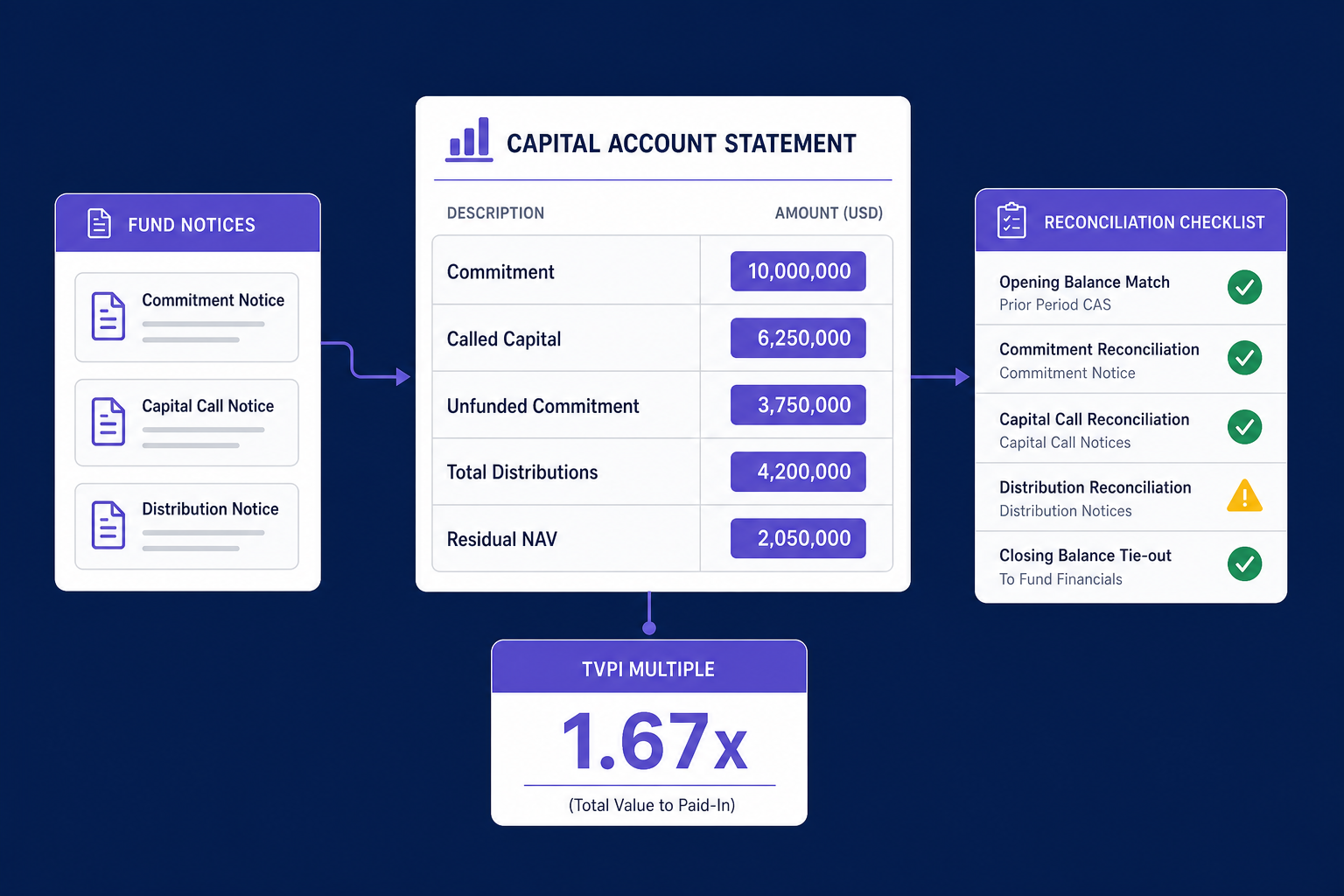
Notices are the most operationally urgent documents in the LP's reporting stack — but they're only one piece of the picture. The Capital Account Statement (CAS) provides the cumulative position view that puts each notice in context: total capital called to date, total distributions received, current NAV, and unfunded commitment balance.
How Tamarix helps: Tamarix uses AI trained specifically on private markets documents to extract structured data from GP notices — regardless of format. Key fields are automatically identified, classified, and validated, with every extraction traceable to the source document. Unfunded commitment impacts are calculated automatically, including recallable distribution logic. Book a demo to learn more.
FAQ
What is a capital call notice in private equity?
A capital call notice is a formal document issued by a General Partner (GP) to its Limited Partners (LPs) requesting them to contribute a specified amount of capital to the fund. Calls are made to fund new investments, support existing portfolio companies, or cover management fees and fund expenses. The notice specifies the amount due, the payable date, and typically a breakdown of what the capital is being used for. Most calls occur during a fund's investment period — the first three to five years — though fee-related calls continue throughout the fund's life.
What is a distribution notice in private equity?
A distribution notice is a document issued by a GP notifying LPs that they will receive a payment from the fund. Distributions arise from portfolio company exits (partial or full), income events such as dividends or interest payments, or the return of excess fee reserves. The notice specifies the amount to be received, the payment date, and a breakdown of the distribution into components: return of capital, realised gains, and income. For tax and accounting purposes, the breakdown is material — each component may be treated differently.
What is the difference between a capital call and a distribution notice?
A capital call notice requires the LP to wire money to the fund; a distribution notice announces money coming the other way, from the fund to the LP. Calls reduce the LP's unfunded commitment (in most cases); distributions generally do not affect unfunded commitment unless they are classified as recallable, in which case they increase it. Calls are concentrated in the early years of a fund's life; distributions in the later years, though income-focused strategies (private debt, infrastructure) may distribute from year one.
What does 'unfunded commitment' mean in a capital call notice?
Unfunded commitment is the portion of an LP's total capital commitment that has not yet been drawn by the GP. Each in-commitment capital call reduces the unfunded commitment by the amount called. For example, if an LP has committed $5,000,000 and $2,000,000 has been called to date, the unfunded commitment is $3,000,000. The notice will typically state the unfunded commitment before and after the call, though this is not universal. Recallable distributions increase the unfunded commitment, effectively re-opening capital that can be called again.
What is a recallable distribution?
A recallable distribution is a distribution that the GP retains the right to call back in the future. Under the fund's LPA, certain distributions — typically those made before the fund has returned the LP's full capital contribution — may be designated as recallable. When an LP receives a recallable distribution, their unfunded commitment increases by the recallable amount, meaning the GP can redraw that capital for future investments or fees. This is a common source of reconciliation error in LP accounting workflows.
What is a simultaneous call and distribution notice?
A simultaneous notice — sometimes called a net notice — is a single document issued by the GP that combines a capital call and a distribution, netting the two amounts against each other. This typically occurs when the GP is simultaneously exiting an investment (generating distribution proceeds) and calling capital for fees or a new investment. The notice will show both components separately and state the net amount payable or receivable. For LP accounting purposes, the call and distribution components should be recorded separately, even though only one cash movement occurs.
How many capital call and distribution notices will an LP receive over a fund's life?
The total number of notices varies by fund strategy and deal velocity, but a typical LP can expect 30–60 notices over the life of a single fund commitment — roughly split between calls and distributions. Buyout funds with concentrated portfolios may issue fewer, larger notices; private debt or real estate funds with higher activity may issue more. For an LP with 20–30 fund commitments, this translates to 600–1,800 notices over the life of those investments, with 30–80 notices arriving in any given year.
What is the ILPA standard for capital call and distribution notices?
The Institutional Limited Partners Association (ILPA) has published a standardised template for capital call and distribution notices, designed to improve consistency and comparability across GPs. The ILPA template includes standardised fields for fund and LP identification, payable dates, net amounts, call and distribution breakdowns (including in/out-of-commitment and recallable classifications), unfunded commitment impacts, and payment details. Adoption of the ILPA notice template is growing, particularly among larger institutional GPs, but remains optional — many GPs continue to use proprietary formats.
Why is automating capital call notice processing difficult?
Automating notice processing is challenging for three reasons. First, there is no universal format — every GP produces notices in their own template, with different field labels, layouts, and levels of detail. Second, GPs change their formats over time, breaking rule-based extraction logic. Third, the edge cases — out-of-commitment calls, recallable distributions, simultaneous notices, equalisation entries — require contextual interpretation, not just field extraction. These cases occur frequently enough that they can't be handled as exceptions; they must be part of any robust automation framework. General-purpose OCR tools handle the straightforward cases but fail systematically on the edge cases that matter most for accuracy.