The Hidden Cost of Managing GP Portals Across a Growing Portfolio
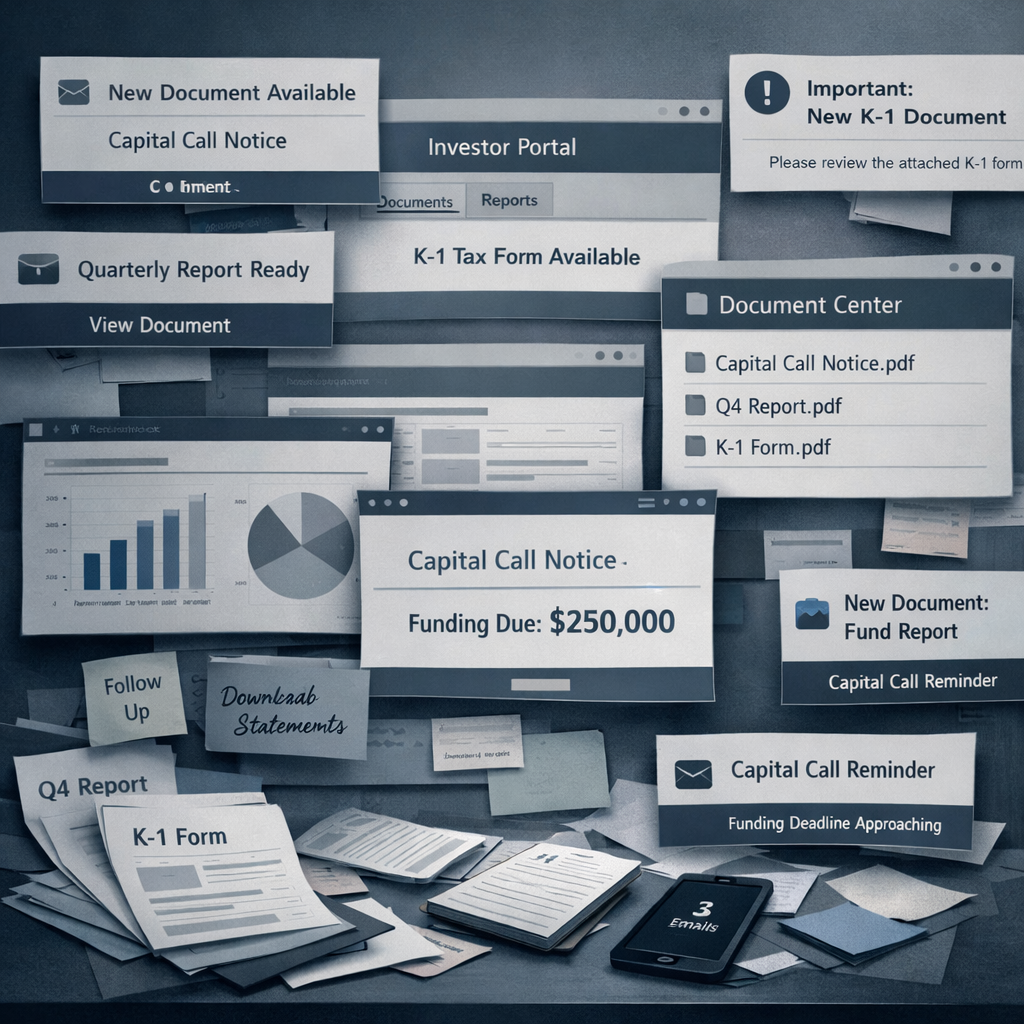
Most LP teams know the feeling. A new fund commitment closes, onboarding completes, and then — almost immediately — the administrative reality of that relationship begins. Another portal to register on. Another set of credentials to store somewhere. Another MFA workflow to manage. Another notification stream to monitor alongside the twenty others already running.
Individually, none of it feels significant. Collectively, it adds up to something that most LP teams significantly underestimate: a structural operational cost that grows with every fund relationship added to the portfolio, and compounds in ways that aren't visible until they become a serious problem.
This post is about making that cost visible.
The portfolio growth trap
Private markets allocators are, almost by definition, in the business of adding fund relationships over time. A maturing portfolio doesn't shrink — it deepens. Re-ups with existing managers, commitments to new strategies, exposure to new geographies or asset classes. Each of these is a deliberate investment decision. What's rarely deliberate is the operational infrastructure that decision requires.
The problem is that most LP operational models were designed for a smaller portfolio than the one they're currently running. Workflows that were sustainable at 15 fund relationships start to strain at 30. At 50 or more, they break — not dramatically, but gradually, in ways that are easy to attribute to other causes. A missed notification here. A delayed capital call payment there. A quarterly report that didn't make it into the monitoring cycle in time.
As we explored in our previous post on fund document collection, the root issue is that document retrieval across GP portals is fundamentally manual — and manual workflows don't scale. What we want to examine here is what that failure to scale actually costs.
The three cost layers nobody is measuring
Headcount cost
The most direct cost of managing GP portals is time, and time in an investment operations context is expensive. Consider what a realistic document retrieval workflow looks like at scale: monitoring email notifications across dozens of GPs, logging into each portal to retrieve documents, managing credentials and MFA across the team, downloading, naming, and filing each document according to the team's conventions.
At a portfolio of 50 fund relationships, with each generating quarterly reports, capital account statements, capital call and distribution notices, and annual tax documents, the volume of individual retrieval tasks runs into the hundreds per quarter. If each task takes an average of 15 minutes — a conservative estimate once MFA friction and portal navigation are included — that's dozens of hours of skilled operations time consumed every quarter on work that produces no analytical value.
Operations and analyst professionals at LP organisations represent a significant cost base — allocating a meaningful fraction of their time to document retrieval is an expensive way to solve a problem that doesn't require human judgment to solve.
Downstream data cost
The second cost layer is less visible but arguably more consequential. Document collection isn't an end in itself — it's the input to everything else. NAV monitoring, performance reporting, manager diligence, portfolio construction decisions — all of these depend on having complete, current fund data. And fund data starts with documents.
When collection is manual, it is by definition incomplete and delayed. Documents sit in inboxes waiting to be retrieved. Some notifications are missed entirely. Some portal visits find documents that weren't available the last time someone logged in. The result is a data layer that is perpetually slightly out of date — and decisions made on slightly out-of-date data are, in aggregate, worse decisions.
This cost is invisible on any operational budget. It doesn't show up as a line item. But it is real, and in a private markets context where portfolio monitoring depends on timely information, the gap between what you know and what has actually happened is a risk that compounds over time.
Operational risk cost
The third layer is risk. Manual document workflows create exposure in several specific ways.
Capital call processing is the most acute. A capital call notice that isn't retrieved promptly — because it's buried in a notification email that didn't get triaged, or sitting in a portal that nobody checked that week — creates the possibility of a missed funding deadline. The consequences range from financial penalties to lasting damage to the LP-GP relationship. In a market where GP access is often competitively allocated, reputational damage with a manager is not a recoverable cost.
Compliance and audit exposure is subtler but persistent. LP teams are increasingly subject to reporting requirements that depend on having a complete, organised, auditable record of fund documentation. When documents are manually downloaded and stored across various systems and formats, gaps and inconsistencies are inevitable. These gaps create reconciliation overhead at best and compliance exposure at worst.
Credential management is a third risk vector. Most LP teams with manual portal workflows have, at some point, resorted to informal credential sharing — spreadsheets, email, messaging apps. Each of these represents a security exposure that most compliance frameworks would flag if examined closely.
Why the "hire more people" answer doesn't work
The reflex response to operational strain is headcount. If document retrieval is taking too long, assign more resource to it. If credential management is a bottleneck, make one person responsible for it. If the data layer is incomplete, add a step to the process.
This approach has two problems. The first is economic: operations headcount is expensive, and adding people to manage a fundamentally inefficient process means spending more to get the same inadequate outcome. The second is strategic: it anchors the operational model to the current portfolio size. The next round of fund commitments requires more headcount. And the round after that. An LP organisation that scales headcount with portfolio size has not solved the operational problem — it has institutionalised it.
The more durable solution is to change the architecture of the problem, not the number of people managing it.
What a scalable document infrastructure looks like
The LP teams that have genuinely solved the GP portal management problem have one thing in common: they've decoupled document collection from human attention. Rather than relying on people to monitor, retrieve, and file documents, they've built — or adopted — infrastructure that does this continuously and automatically.
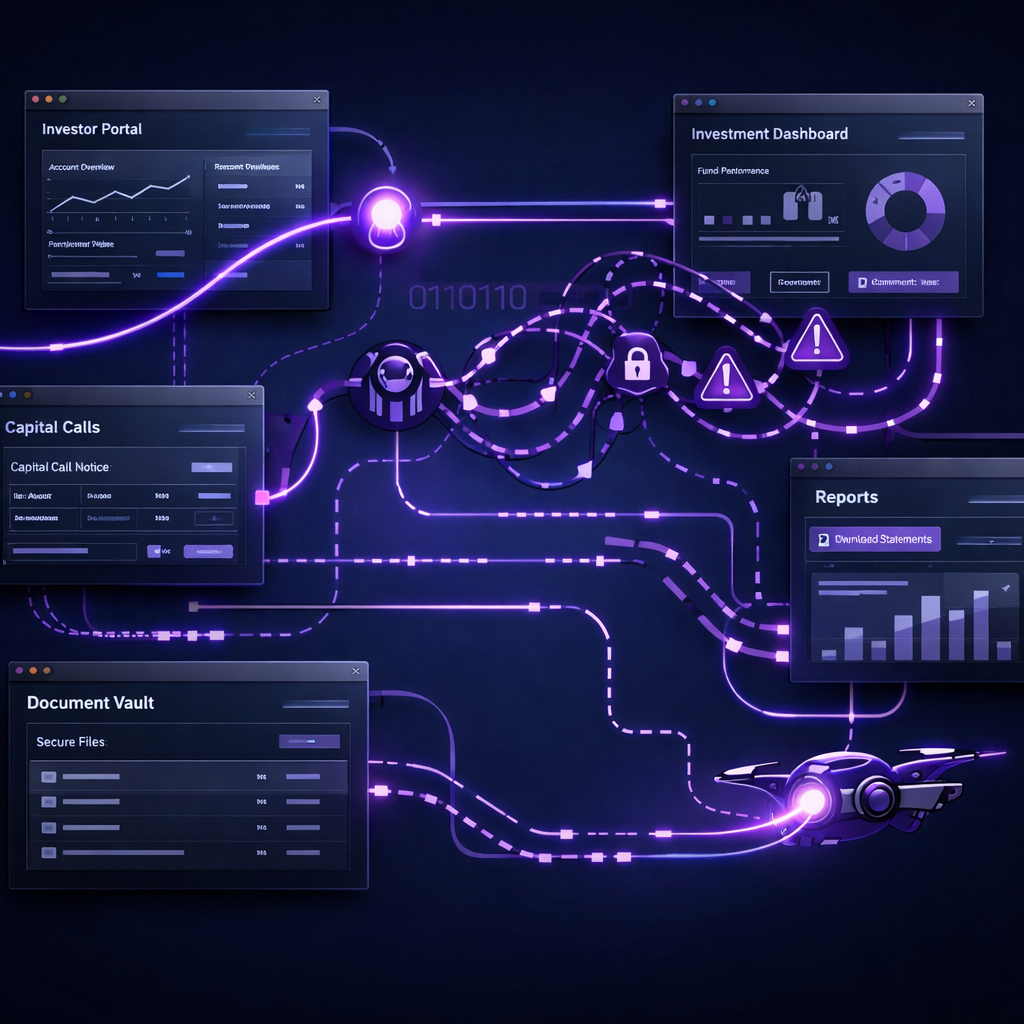
The characteristics of that infrastructure are consistent. It monitors GP email notifications and LP portals on an always-on basis, so nothing is missed between manual retrieval cycles. It manages credentials and MFA workflows without requiring team members to maintain or rotate access manually. It categorises documents automatically by fund, manager, document type, and reporting period, so the filing work is done before anyone looks at the document. And it connects directly to downstream workflows — data extraction, monitoring, reporting — so the delay between document arrival and data availability collapses to near zero.
The practical effect is that portfolio growth stops generating proportional operational overhead. Adding a new fund relationship means adding another relationship to monitor — not another set of manual tasks to absorb.
How Tamarix approaches this
Tamarix was built specifically to solve the document infrastructure problem for LP teams. The platform runs always-on collection across GP email notifications and LP portals, handles credential and MFA management on behalf of clients, and automatically organises every document into a clean, structured layer linked to the correct fund, manager, and reporting period.
Because document collection is the foundation of Tamarix's broader operating system, captured documents flow immediately into data extraction, validation, monitoring, and reporting workflows. The result is a document layer that is always complete, always current, and always connected to the analytical tools that depend on it — regardless of how many fund relationships the portfolio contains.
For LP teams that are feeling the strain of portfolio growth on their current operational model, the question is not whether document infrastructure needs to change. It's how much longer the current approach can absorb the next round of commitments before it breaks.
Want to see how Tamarix handles GP portal management across your full fund universe? Explore the document collection product — or schedule a call if you'd like to talk through your specific setup.
Frequently asked questions
Why do LP teams struggle to manage GP portals as their portfolio grows? As LP portfolios grow, teams must manage an increasing number of separate investor portals — each with its own login credentials, MFA setup, and navigation structure. What starts as a manageable administrative task at 10–15 fund relationships becomes a significant and compounding operational burden at 30, 50, or 100+. Managing access and retrieving documents across this fragmented portal landscape is one of the most consistent operational drains in private markets.
How many GP portals does a typical LP manage? This varies considerably by portfolio size and strategy. A mid-sized LP with 30–50 fund relationships might actively manage 20 or more distinct portals, since some GPs use shared platforms while others maintain proprietary systems. Large institutional allocators with 100+ relationships can face significantly higher portal counts, often with inconsistent document delivery conventions across each one.
What does GP document management cost LP teams in practice? The direct cost is operational time: at scale, manual document retrieval and filing can consume dozens of hours of skilled operations time per quarter. The indirect costs — delayed data flowing into monitoring and reporting workflows, and the risk exposure from missed capital call notifications or incomplete compliance records — are harder to quantify but often more consequential.
Why is manual document collection a risk as well as an inefficiency? The most acute risk is around capital call processing. A missed or delayed capital call notification can result in a funding deadline being missed, which carries financial penalties and potential reputational damage with the GP. Beyond capital calls, manual workflows create compliance and audit exposure through incomplete documentation records, and security exposure through informal credential sharing practices.
How does document collection affect downstream LP workflows? Document collection is the first step in the LP data chain. NAV monitoring, performance reporting, manager diligence, and portfolio construction decisions all depend on having complete, current fund documents. When collection is manual and delayed, every downstream workflow runs on incomplete data — creating a persistent gap between what LP teams know and what has actually happened in their portfolio.
At what portfolio size does manual document management become unsustainable? There is no universal threshold, but most LP teams begin to feel meaningful strain in the range of 30–50 active fund relationships, particularly during peak reporting periods such as quarter-end and year-end. The breaking point depends on team size, document volume per relationship, and the complexity of the portals involved. The more important point is that the strain compounds with each new commitment — the question is not whether the current model will break, but when.
How does Tamarix help LP teams manage GP portals across a growing portfolio? Tamarix replaces manual portal monitoring and document retrieval with continuous, automated collection across the full GP universe. The platform manages credentials and MFA on behalf of LP teams, categorises documents automatically, and feeds them directly into downstream data and reporting workflows. As portfolios grow, the document layer scales automatically — without adding operational overhead.